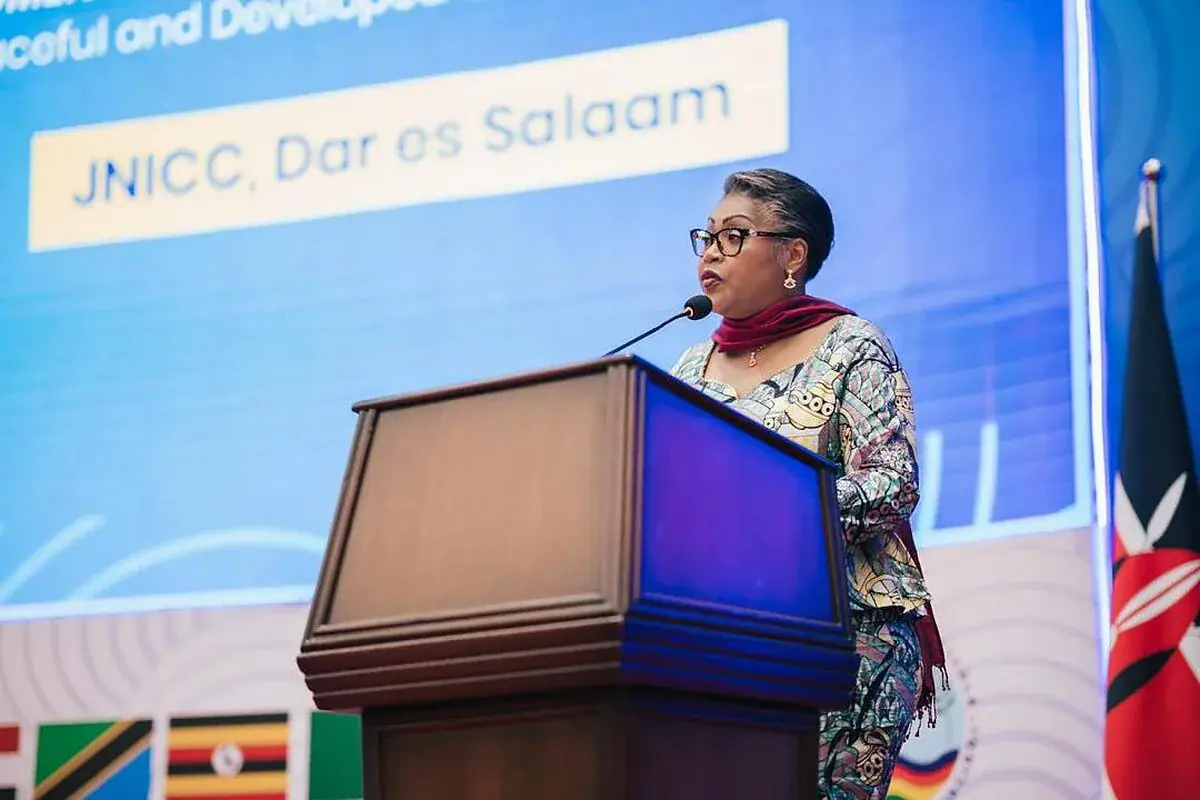
Twenty years after the signing of the Nairobi Pact on security, stability, and development in the Great Lakes region, peace efforts continue to face challenges. On November 2, 2026, in Dar es-Salaam, DR Congo's Prime Minister Judith Suminwa Tuluka addressed parliamentarians, emphasizing the need for women's participation in peace and security efforts. She called for a shift from mere representation to real influence and results. The Prime Minister's remarks were made at the opening of the Parliamentary Conference on Women for Peace and Development in the Great Lakes region.
Judith Suminwa highlighted the importance of measuring progress in women's political participation and translating regional and international commitments into concrete actions. She cited prevention of conflicts, mediation, reconstruction, and decision-making as areas where women must exercise real influence. The Prime Minister specifically addressed the security situation in eastern DR Congo, condemning violence attributed to the Rwandan army and its affiliates. She denounced the heavy toll of violence on women and young girls in conflict-affected areas.
The Prime Minister paid tribute to Congolese women affected by armed violence, displacement, and poverty. She acknowledged their role in maintaining social cohesion despite insecurity and advocated for their recognition as essential actors in finding durable solutions to conflicts. Judith Suminwa emphasized that peace in the region must be based on respect for states' sovereignty and territorial integrity, protection of civilians, and effective involvement of women in prevention, mediation, and reconstruction mechanisms.
On the national level, Judith Suminwa reaffirmed DR Congo's commitment to women's rights, as enshrined in the Constitution. She aligned with President Félix-Antoine Tshisekedi Tshilombo's vision of promoting positive masculinity. However, the Prime Minister stressed that legal texts alone cannot transform women's lives; their implementation requires financial resources, coherent public policies, and tangible results.
Judith Suminwa urged parliamentarians to use their legislative, budgetary, and oversight powers to combat discrimination and gender-based violence, promote girls' education, and enhance women's economic autonomy. She encouraged them to support education, health, and economic empowerment for women, as well as aid for displaced persons. The Prime Minister concluded by calling for a shift from rhetoric to action, emphasizing that peace must be a lived reality, not just a repeated promise.
The conference, hosted by Tanzania, brought together politicians, parliamentary leaders, representatives of CIRGL member states, and international partners. The Tanzanian Vice-President, Deogratius John Ndejembi, highlighted the crucial role of women in conflict prevention, peacebuilding, and sustainable development. He advocated for their effective participation in decision-making bodies and processes.
The outcome of the conference will depend on whether the commitments made in Dar es-Salaam translate into concrete policy decisions and budget allocations that address the expectations of women, particularly those living with the consequences of conflicts in eastern DR Congo.
Key points
- Judith Suminwa calls for a shift from women's representation to real influence in peace and security efforts.
- The conference aims to prioritize women's leadership in responses to crises in the Great Lakes region.
- DR Congo's Prime Minister emphasizes the need for concrete actions to address women's rights and empowerment.