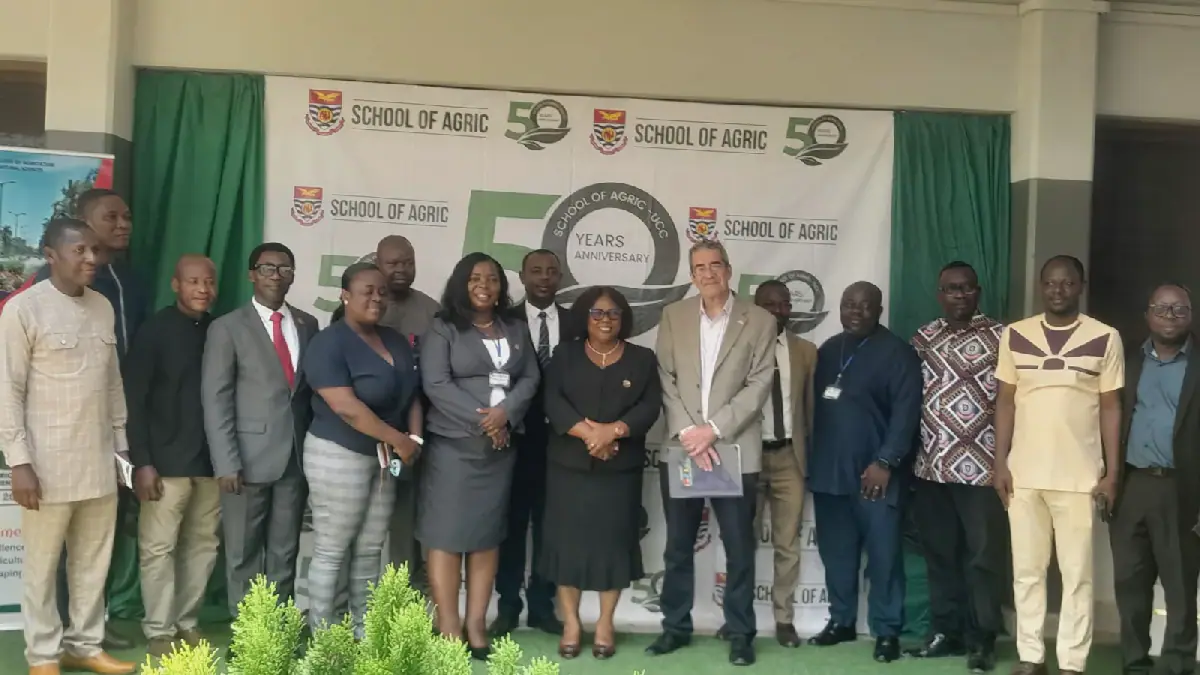
The University of Cape Coast (UCC) has established the Africa Centre for Food Integrity (AFIC) to tackle food safety and quality challenges in Ghana and Africa. The centre, set up by the College of Agriculture and Natural Sciences (CANS), aims to research and develop mobile digital technologies enabled by artificial intelligence (AI) to assess food quality in real-time. This initiative seeks to strengthen food quality assurance and protect food systems against deliberate contamination and food fraud.
Food fraud, the deliberate adulteration or misrepresentation of food for financial gain, poses a significant threat to public health. In Ghana, instances of food fraud include adulterating palm oil with Sudan IV dye, mixing ginger powder with sawdust, and adding flour to groundnut paste. The AFIC is developing AI-powered technologies that mimic human sense organs to authenticate food safety and quality. Reverend Professor Ernest Teye, Agri-Food Integrity expert and Centre Lead, explained that the centre was conceived nine years ago in response to concerns about endemic food contamination and adulteration.
The AFIC has developed a mobile-enabled spectroscopic device that can assess the safety and quality of palm oil within seconds. The centre is also preparing to introduce Spice Check, a technology to authenticate spices consumed in Ghana. Additionally, a cocoa passport system has been developed to trace cocoa beans to their place of production. Prof Teye emphasized that the centre's goal is to ensure that food consumed by the public is safe, authentic, and sustainable, thereby protecting public health and supporting sustainable development.
Prof Rofela Combey, Provost of CANS, assured that AFIC would work with farmers, scientists, industry players, educators, policymakers, and regulators to ensure food produced, sold, and consumed in Ghana and across Africa is safe. She called for collective responsibility in promoting food safety and protecting the quality of food for present and future generations. The centre will collaborate with key stakeholders, including the Food and Drugs Authority (FDA) and the Ghana Standards Authority.
Prof Chris Elliott, a food safety expert with Queen's University Belfast, emphasized the need for Africa to address food safety risks, food fraud, and trade barriers to unlock its vast agricultural potential. Despite holding about 60% of the world's uncultivated arable land, Africa accounts for less than 4% of global food exports. Elliott noted that projections suggest the continent's food export could rise to 25% with continued agriculture expansion and modernization.
Professor Christine Adu-Yeboah, Pro Vice-Chancellor of UCC, said AFIC would become a continental hub where governments, regulators, industry players, and researchers could access knowledge, expertise, and technology to protect food integrity. She emphasized that food integrity is ultimately about trust, trust that what is labelled is what is contained, and trust that what is sold is safe.
The inauguration of AFIC has garnered support from various stakeholders, including the Ambassador of the State of Israel to Ghana, Liberia, and Sierra Leone, Mr Roey Gilad. He commended UCC for the centre and pledged Israel's support for the project through capacity-building initiatives and partnerships with Israeli universities. The centre's establishment marks a significant step towards ensuring food safety and quality in Ghana and Africa.
Key points
- The University of Cape Coast has established the Africa Centre for Food Integrity to tackle food safety and quality challenges.
- The centre aims to develop mobile digital technologies enabled by artificial intelligence to assess food quality in real-time.
- Food fraud poses a significant threat to public health, with instances including adulterating palm oil and mixing ginger powder with sawdust.