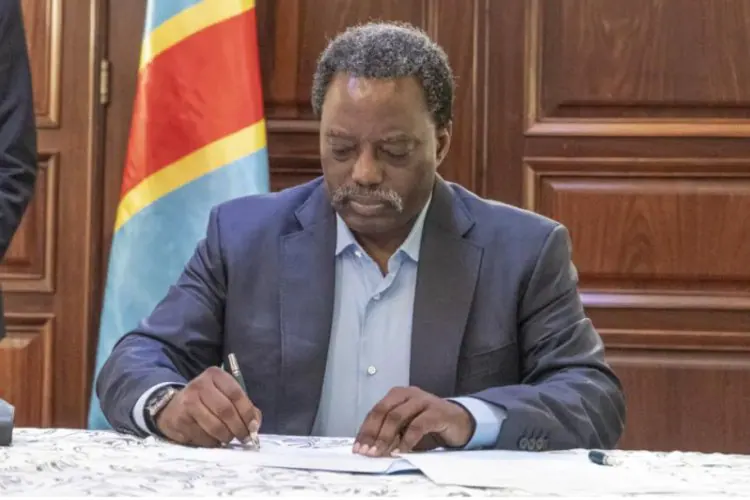
Joseph Kabila, the former President of the Democratic Republic of Congo (DRC), has been appointed as the leader of a new political and military alliance, Front pour la Refondation de la Nation (FRN). This alliance brings together the Alliance Fleuve Congo (AFC) and the M23 group, with the aim of uniting forces to fight against what they describe as tyranny in the country. The announcement was made on October 12, 2026, in the city of Goma, which has been under M23 control since January 2025.
The new alliance was announced during a press conference at Kabila's residence, attended by other leaders of the FRN. Claude Ibalanky, a former special ambassador to President Félix Tshisekedi, revealed the establishment of the FRN. He stated that the members have committed to pooling their resources, assets, and capabilities to work together to liberate the country. Ibalanky explained that the creation of the FRN is based on Article 64 of the DRC's Constitution, which stipulates that Congolese citizens have a duty to resist any individual or group that seizes power by force or exercises it in a manner contrary to the Constitution.
Kabila will be joined by Corneille Nangaa, who previously coordinated AFC activities; Bertrand Bisimwa, the former leader of the M23; and General Sultani Makenga, who commanded AFC-M23 forces. The FRN has declared that its objective is to unite all forces opposing the current regime, with the goal of putting an end to what they describe as tyranny, using all means, including military force. The alliance has also established a permanent secretariat, which will provide further details on its structure and major announcements in the coming days.
Kabila, 55, ruled the DRC from 2001 to 2019 and was sentenced to death in absentia in September 2025 for crimes including conspiracy and war crimes. The Congolese military court accused him of being one of the masterminds behind the creation of the AFC-M23 alliance. The M23 group has been involved in ongoing conflicts in the DRC, particularly in the eastern regions.
The creation of the FRN and Kabila's appointment as its leader are likely to have significant implications for the country's politics and security situation. The alliance's goals and strategies will be closely watched, both domestically and internationally, as the DRC continues to face challenges related to governance, stability, and conflict.
The international community has been following developments in the DRC closely, with concerns about the country's stability and the humanitarian situation in conflict-affected areas. The role of external actors, including neighboring countries and international organizations, may also be impacted by the emergence of the FRN and Kabila's new role.
As the situation in the DRC continues to evolve, the FRN's actions and decisions will be subject to scrutiny and analysis. The alliance's ability to achieve its objectives and its impact on the country's politics and security situation remain to be seen.
Key points
- Joseph Kabila has been appointed leader of a new alliance between the AFC and M23 groups in the DRC.
- The alliance aims to unite forces to fight against what they describe as tyranny in the country.
- Kabila's appointment has significant implications for the country's politics and security situation.