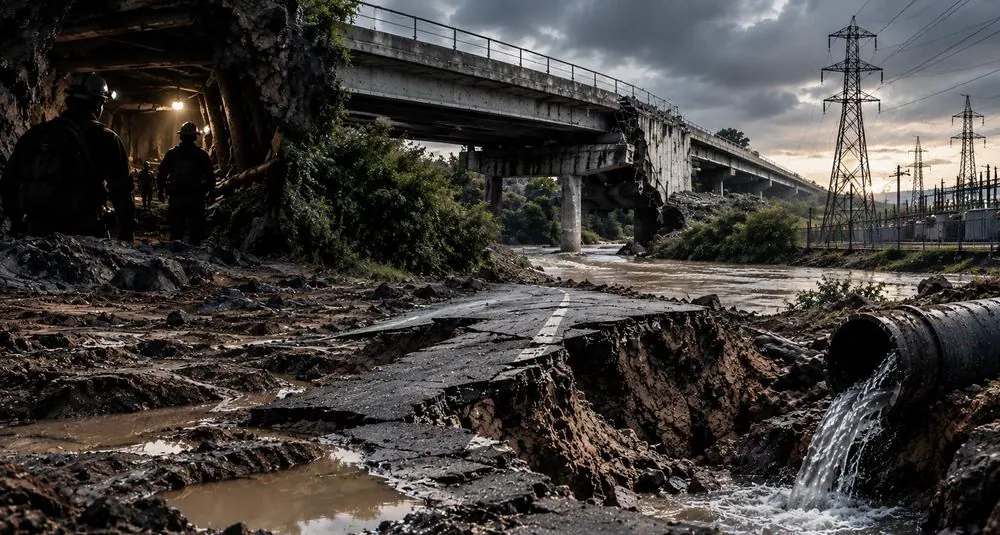
Illegal mining in South Africa is causing widespread damage to critical infrastructure, including roads, bridges, and utilities. The Department of Mineral and Petroleum Resources (DMPR) has described the issue as "rife and extremely serious," with severe consequences for legitimate mining operations and surrounding communities. The damage is no longer limited to abandoned shafts and mine workings, but is now affecting public infrastructure, the environment, and the economy.
The City of Johannesburg has begun quantifying the damage caused by illegal mining, with investigations revealing underground voids as deep as 22 meters beneath road surfaces. The Johannesburg Roads Agency (JRA) has identified several areas affected by illegal mining, including John and Webber Streets in Booysens, Wemmerpan Road in Turffontein, and Nick Toomey Boulevard in Roodepoort. The city's infrastructure, including roads, bridges, stormwater systems, and electricity infrastructure, is being severely impacted.
The City of Johannesburg estimates that R262 million is required to fully reinstate five roads affected by illegal mining. Preliminary assessments of M1 and M2 bridge structures have put repairs to abutments and parapet walls at close to R23 million. However, the city does not have consolidated city-wide figures that quantify the full financial impact of illegal mining over the past three years. The city's infrastructure is not the only concern, with environmental degradation and mounting pressure on the state to fund repairs and rehabilitation also major issues.
City Power is also confronting a similar threat beneath the electricity network, with illegal underground mining threatening critical infrastructure around the Robertville and Roodepoort substations and along the Main Reef corridor. Underground excavations have compromised ground stability, placing substations, transformers, pylons, and transmission towers at risk. In some areas, infrastructure has already begun to sink as illegal mining activity continues beneath the surface.
The infrastructure threat is not unique to Gauteng, with the North West provincial legislature recently raising concerns about illegal mining and unauthorized chrome wash plants in Bojanala and Madibeng. The committee cited environmental damage, water pollution, unsafe excavations, and inadequate enforcement capacity as major concerns. The province has also faced a deadly human toll, with the DMPR confirming an incident in Nkaneng, Rustenburg, in August in which illegal miners died.
The issue of illegal mining has sparked calls for a legal pathway for artisanal miners. UASA Divisional Manager: Mining Nico van Rooyen said that illegal mining threatens the livelihoods and safety of legal employees, while also undermining the sustainability of companies whose operations are being illegally exploited. However, MACUA National Coordinator Sabelo Mnguni said that enforcement alone cannot resolve the underlying problem, and that a realistic pathway for artisanal miners to enter the legal mining economy is needed.
The DMPR is working with law-enforcement agencies through joint operations, including Vala Umgodi and Operation Prosper, to disrupt and dismantle illegal mining operations. The department has also acknowledged the impact of illegal mining on legitimate mining operations and communities, and has emphasized the need for urgent attention to address the issue. The city's efforts to quantify and address the damage caused by illegal mining are ongoing, with a focus on finding a long-term solution to the problem.
Key points
- Johannesburg faces a R262m bill to repair roads damaged by illegal mining.
- The city's infrastructure, including roads, bridges, and utilities, is being severely impacted by illegal mining.
- A legal pathway for artisanal miners is needed to address the underlying problem of illegal mining.