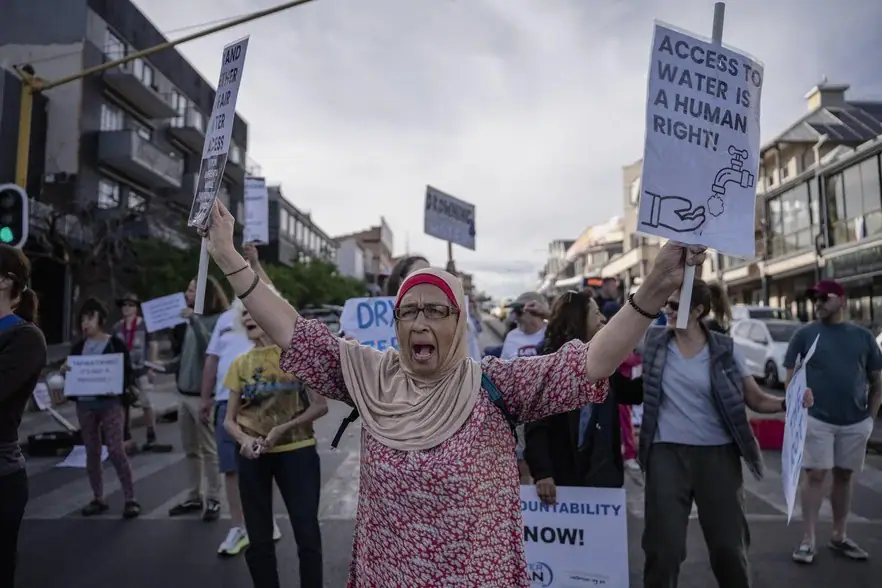
Residents across Johannesburg have taken to the streets, protesting against recurring water outages, lack of communication, and planned water throttling. The protests occurred a week before the local government elections, with residents venting their frustration over years of ongoing problems with Johannesburg's water supply. Chants of "Amanzi, awethu! Amanzi, awethu!" (Water is ours!) echoed through the streets as protesters demanded a permanent solution to the city's water crisis.
Rashida Mather, a Brixton resident and dementia care specialist, joined two protests this week, highlighting the struggles of caring for patients without reliable water supply. She has to haul heavy buckets of water up and down her street to care for a patient who has recently had three strokes. Mather emphasized that it is a daily "nightmare" to get enough water for bed laundry and keep up basic hygiene. Her situation is not unique, with many residents facing similar challenges.
In Parktown, 93-year-old Gilly Pirrow, a Johannesburg resident since 1955, protested on Jan Smuts Avenue about prolonged water outages. The current outage started in early August, and Pirrow is physically unable to carry water from tankers during these outages. Similarly, in Kensington, protesters gathered on busy Queen Street, objecting to water throttling, which has left the area without water for over a week. Nonie Zulu, a Kensington resident, expressed concerns about children studying for exams without water and being unable to bathe.
Johannesburg Water (JW) and Rand Water (RW), the entity's bulk water supplier, have issued warnings about water shortages. JW stated that water supply systems are "severely constrained," with high household, commercial, and municipal demand preventing reservoirs and towers from recovering. This has resulted in low water pressure, intermittent supply, and prolonged outages in various areas. JW is implementing targeted throttling to balance available supply, support reservoir recovery, and stabilize distribution across affected systems.
The throttling measures will affect several areas, including Commando, Central, Sandton, Midrand, Randburg-Roodepoort, Soweto, and southern areas. JW has proposed restrictions to reduce consumption, such as banning irrigation of public parks and gardens, requiring hosepipe spray nozzles, and prohibiting the hosing down of hard surfaces and dampening of building sand. If demand continues to rise, JW may consider Level 2 restrictions, with Level 1 restrictions currently in place.
Rand Water warned that Johannesburg has exceeded its temporary water-use target every month from January to September 2026. RW is already pumping at full capacity and will hold municipalities that keep overconsuming to their limits. The target for Johannesburg is 1,528 megalitres (ML) per day, but consumption peaked at 1,765ML/day in January and was still above the limit at 1,724ML/day in September. RW may restrict bulk water supplies to municipalities exceeding their allocations, resulting in low pressure and intermittent outages.
Water expert Richard Holden noted that Johannesburg's geographical position makes supplying water to higher-lying areas particularly challenging. The system is vulnerable to power failures, pump breakdowns, and leaking reservoirs. Ingrid Bester, a Kensington resident and member of the Johannesburg Water Crisis Committee, emphasized that some reservoirs are currently bypassed due to cracks and leaks. Bester also highlighted that the new Brixton reservoir and water tower have not resolved shortages, citing a lack of operational funds due to historical underfunding by the City of Johannesburg.
Key points
- Johannesburg residents protest over recurring water outages and planned throttling.
- Water supply systems are "severely constrained" due to high demand and lack of funding.
- Proposed restrictions include banning irrigation of public parks and gardens, and prohibiting hosepipe use.