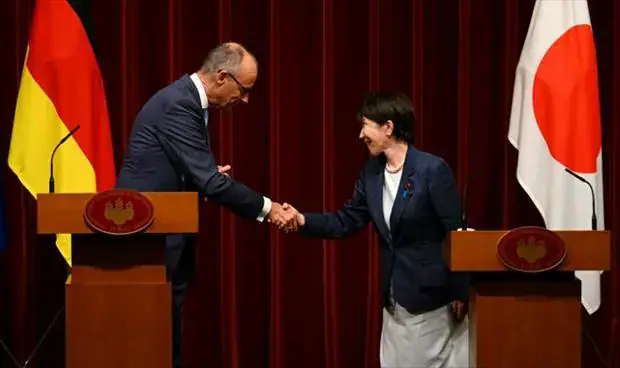
Japanese Prime Minister Fumio Kishida and German Chancellor Friedrich Merz have agreed to enhance cooperation on critical minerals, a move that seeks to reduce reliance on China, which currently dominates the global market for rare earth minerals used in various products, from batteries to missiles. This agreement was reached during a meeting in Tokyo on October 28, 2026.
The cooperation aims to develop alternative supply sources and protect critical technologies. The two leaders expressed concern over the increasing use of economic coercion, including arbitrary export restrictions and retaliatory measures affecting critical minerals. They pledged to work together to ensure that any attempts to exploit economic dependency as a weapon would fail.
Tensions between China and Japan have been escalating, particularly since a diplomatic spat last year over Taiwan. China has since tightened controls on exports of certain products to Japan, including some rare earth minerals. Japan's relations with China have been further strained after Kishida's comments suggesting Japan might intervene militarily if Taiwan were attacked.
Chancellor Merz emphasized the need for the European Union, Japan, and Germany to reduce their dependence on a single supplier for critical minerals and materials. He proposed establishing a global political alliance for rule-based trade, highlighting the importance of diversifying supply chains and reducing risks.
The agreement between Japan and Germany reflects a broader effort to mitigate risks associated with supply chain dependencies. Merz's visit to Tokyo was part of a regional tour that included stops in Singapore and South Korea. The two leaders' discussions also touched on promoting a rules-based international trade order.
The critical minerals sector has become a focal point for geopolitical competition, with China playing a dominant role. Japan and Germany's cooperation aims to create a more balanced and resilient global supply chain for these essential materials, which are crucial for various industries, including technology and defense.
By working together, Japan and Germany seek to ensure a stable and secure supply of critical minerals, reducing their vulnerability to economic coercion and supply chain disruptions. This partnership is part of a broader strategy to promote economic resilience and diversification in the face of growing global competition.
Key points
- Japan and Germany have agreed to cooperate on critical minerals to reduce their reliance on China.
- The agreement aims to diversify supply sources and protect critical technologies.
- The partnership reflects a broader effort to mitigate risks associated with supply chain dependencies and promote a rules-based international trade order.