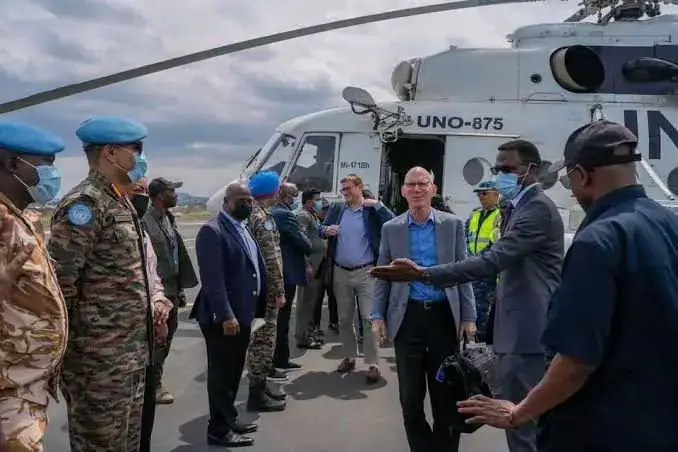
On November 2, James Swan, the head of the United Nations Mission in the Democratic Republic of Congo (MONUSCO), arrived in Goma, the capital of North Kivu province. This was his first visit to the city since the creation of the Front for National Refoundation (FRN), a politico-military movement led by former President Joseph Kabila. According to reports, Swan aims to consult with FRN representatives as part of MONUSCO's mandate to protect civilians, ensure humanitarian access, and monitor the ceasefire.
The visit comes at a time of heightened tensions in the region, with the international community rejecting any legitimation of rebel groups. The Group of International Contact and the African Union have expressed concerns over the growing influence of such groups. Swan's consultations with FRN representatives are part of MONUSCO's regular engagement with various stakeholders in the East of the country. The mission has previously established contacts with the Alliance of Democratic Forces for the Liberation of Congo (AFC/M23).
The FRN, led by Kabila, has significant influence in the region, and Swan's visit is seen as an effort to understand the group's stance on key issues. The Mécanisme conjoint de vérification élargi (MCVE+)/EJVM+ plays a crucial role in monitoring the implementation of the ceasefire. Meanwhile, the situation in the East remains volatile, with ongoing clashes and humanitarian concerns.
On a separate note, the debate over constitutional change continues to dominate the country's politics. The examination of the referendum bill by the Parliament's two chambers has reached its second reading, following the incorporation of reservations from the Constitutional Court. If passed, the bill could pave the way for a constitutional referendum.
However, the opposition and the C64 coalition have expressed concerns over the proposed changes, seeking international support to block the move. They are reportedly lobbying in Paris to garner backing against the government's efforts. The developments have sparked fears of escalating tensions and potential instability.
In a related development, the issue of national dialogue and the reconfiguration of political forces has gained traction. Tony Kanku Shiku, the High Representative, has clarified that the proposed dialogue should not be seen as a mechanism for power-sharing or a backdoor for rebel groups to access institutions. His comments come amid ongoing discussions on the country's political future.
The situation in DR Congo remains complex, with multiple stakeholders vying for influence. As James Swan's visit to Goma concludes, attention will shift to the next steps in the country's fragile peace process. The international community will be watching closely, as developments in the region have far-reaching implications for stability and security.
Key points
- James Swan, head of MONUSCO, visits Goma to consult with FRN representatives.
- Debate over constitutional change continues to divide the country's politicians.
- National dialogue and reconfiguration of political forces remain contentious issues.