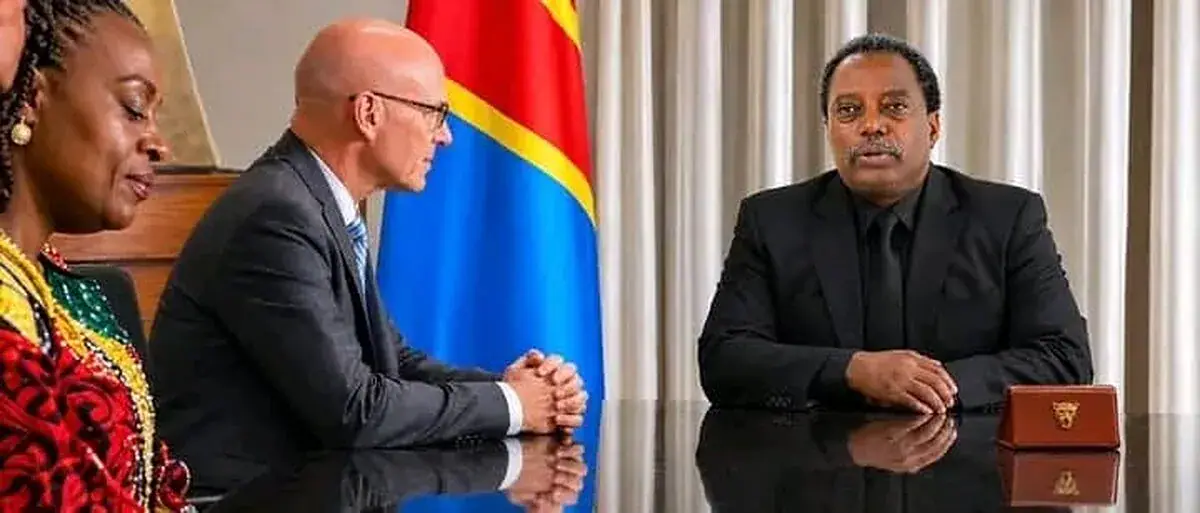
On November 3, James Swan, the head of the United Nations Mission in the Democratic Republic of Congo (MONUSCO), met with Joseph Kabila, the former President of the DRC and current leader of the Front for the Refoundation of the Nation (FRN), in Goma. The meeting focused on peace processes, respect for the ceasefire, and finding a peaceful solution to the ongoing security crisis in eastern DRC. This encounter takes place within a context of political and military recomposition, as well as growing contestation over the role of the MONUSCO.
The FRN, led by Joseph Kabila, was formed on October 12, succeeding the Alliance Fleuve Congo (AFC/M23). According to the MONUSCO, the discussions with Kabila covered the organization's mandate, including protecting civilians, ensuring humanitarian access, and supporting ceasefire monitoring mechanisms. James Swan's visit marked his first trip to Goma since the creation of the FRN and follows ongoing dialogue between MONUSCO and the AFC/M23.
The meeting between Swan and Kabila signals the MONUSCO's efforts to maintain communication channels with influential actors in eastern DRC, despite challenges in achieving a lasting peace. The discussions also reflect the complexities of the peace process, with divergent views on the role of international actors and the future of DRC's institutions. Kabila was accompanied by senior officials, including Corneille Nangaa and Bertrand Bisimwa, while Swan led a high-level delegation.
In parallel to his meeting with Kabila, Swan also met with officials from the Expanded Joint Verification Mechanism Plus (MCVE+), which monitors the ceasefire agreed upon between the Congolese government and rebels under the Doha process. The focus was on efforts to ensure respect for commitments, prevent renewed hostilities, and create conditions for de-escalation in conflict-affected areas.
The FRN has expressed reservations regarding the renewal of MONUSCO's mandate, criticizing its performance as an "total failure." The movement also opposes a potential redeployment of MONUSCO to South Kivu. Furthermore, the FRN warned that any attempt to change the DRC's Constitution could undermine ongoing peace negotiations, potentially collapsing the Doha process.
The meeting between Swan and Kabila highlights the persistent tensions between the FRN and MONUSCO, as well as the challenges facing the peace process. Despite these challenges, MONUSCO reaffirmed its commitment to supporting peace efforts, emphasizing the importance of dialogue and ceasefire monitoring. The outcome of these discussions remains uncertain, with divergences between Kinshasa, the FRN, and international actors continuing to impact prospects for a lasting resolution.
The situation in eastern DRC remains fragile, with ongoing violence and deep-seated rivalries. The MONUSCO's efforts to engage with various stakeholders aim to prevent further escalation and promote a peaceful resolution. As the peace process moves forward, the international community watches closely, seeking a stable and secure future for the region.
Key points
- The meeting between James Swan and Joseph Kabila aimed to discuss peace processes and ceasefire respect in eastern DRC.
- The FRN expressed reservations regarding MONUSCO's mandate renewal and potential redeployment to South Kivu.
- The peace process faces challenges, including divergent views on international actors' roles and DRC's institutional future.