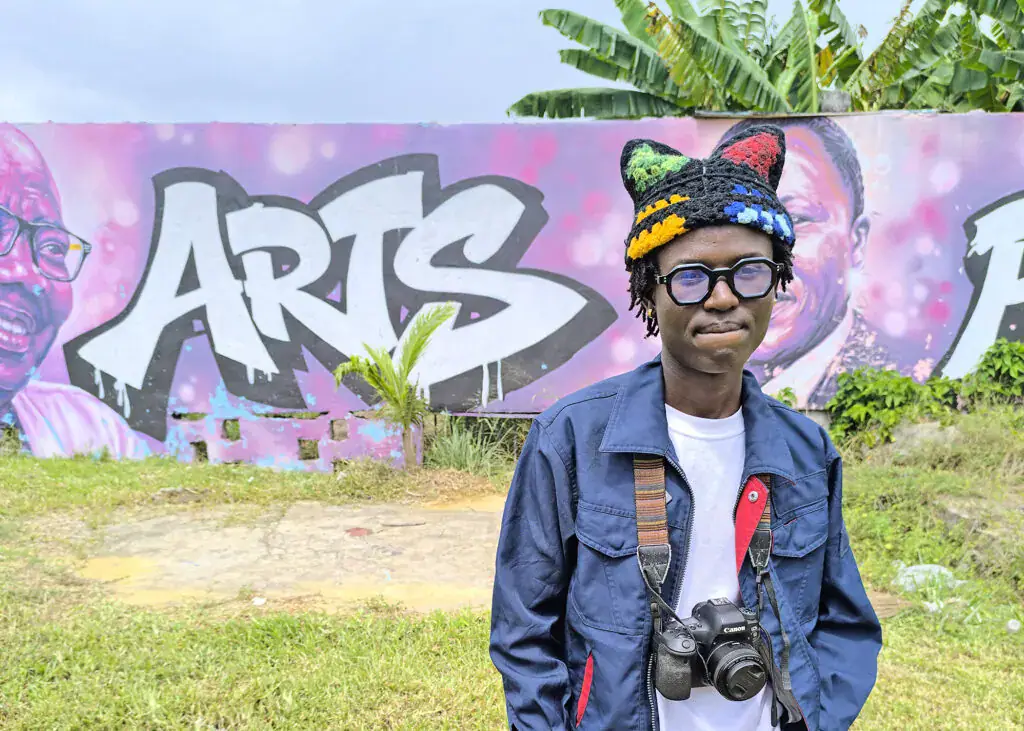
Koné Ibrahim, a 25-year-old Ivorian artist, is developing a unique practice that combines photography and painting to create thought-provoking images. In his studio at the National School of Fine Arts in Abidjan, Ibrahim moves among his materials, including markers, canvases, and a camera. His computer is nearby, used to edit photographs and alter colors and settings to match his vision. This process brings painting and photography together, resulting in images that maintain elements of the painter's approach.
Ibrahim's interest in art began at a young age, learning to draw with his older brother. He later experimented with photography on his mobile phone and studied painting at the National School of Fine Arts. A teacher became a mentor, helping him improve his skills, and he earned a bachelor's degree while developing his photography practice. Ibrahim sees the two disciplines as complementary, with painting teaching him to focus on color, composition, and symbolism, which he now incorporates into his photography.
The African art market is expanding, with global auction sales for modern and contemporary African artists reaching $62.8 million in 2025, up 42.6% from the previous year. However, African dealers report that only 30% of their sales value comes from within the region, raising concerns about how African artists can engage audiences and establish marketplaces closer to home. French-Cameroonian-Malian visual artist Mélissa Sira Traoré notes that African art may be gaining international recognition, but artists still need greater opportunities to have their work seen and valued on the continent.
Ibrahim's practice is part of a broader effort to give African artists greater opportunities to represent their own societies and reach audiences at home. His images can do more than document people and places; they can also question assumptions about everyday life and open up different ways of seeing it. One topic that has piqued his interest is evictions and demolitions, which raise concerns about urban transformation and its effects on those who live there.
Ibrahim's photos attempt to capture the realities of his time, using art to urge viewers to reflect on events from perspectives they would not otherwise encounter. His art also explores communication through things that may arise unexpectedly in photographs. In several of his compositions, he places televisions on his models' heads, emphasizing television's role as a medium for producing and sharing information.
Kouassi Allaman, a second-year master's student, has experienced Ibrahim's method as a model. When Ibrahim first requested him to pose with television screens mounted on his head, he didn't comprehend the concept. However, after seeing the finished piece, Allaman was astonished by the setting, colors, and overall impact. This reaction highlights an important aspect of Ibrahim's practice: the photograph is not always the final statement, and editing and composition enable him to rework the original scene.
Ibrahim's decision to work across disciplines influences the topics he tackles, considering his own experiences, prior years' events, and public-interest concerns. He searches the internet for topics that touch individuals beyond his immediate surroundings and then develops them through his own visual perspective. As the African art market continues to grow, Ibrahim's practice serves as an example of the innovative ways artists are using photography and painting to tell stories and engage audiences.
Key points
- Koné Ibrahim combines photography and painting to explore communication, society, and everyday objects.
- The African art market is expanding, but increased worldwide demand does not always imply that more work circulates inside the continent.
- Ibrahim's practice is part of a broader effort to give African artists greater opportunities to represent their own societies and reach audiences at home.