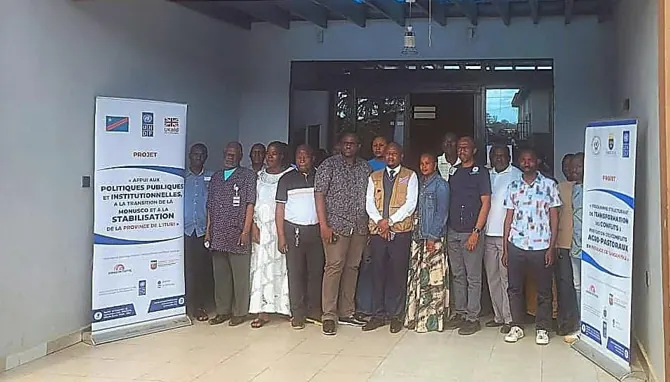
A training program for instructors on animal health and production has been launched in Bunia, the capital of Ituri province in the northeastern Democratic Republic of Congo. The program, organized by the Christian Bilingual University of Congo (UCBC) with technical and financial support from the United Nations Development Programme (UNDP), aims to strengthen the capacity of provincial division of fisheries and livestock cadres and agents. The training will focus on key topics relevant to the province's challenges.
The training program was opened by Fiston Kabaseke, head of the Ituri Provincial Division of Fisheries and Livestock. Kabaseke emphasized that the activity is crucial in the context of challenges related to land and pastoral resource governance, sustainable management of value chains, and application of legal texts regulating the sector. He noted that the program seeks to establish a core group of internal trainers capable of designing and leading pedagogical actions adapted to local realities.
Augustin Twabela, a researcher at the Kinshasa Central Veterinary Laboratory, highlighted the significance of the training, stating that it presents a great opportunity for capacity building for ministry officials. Twabela stressed that the selected topics are of particular interest to the province, which faces challenges related to animal disease surveillance and zoonoses. He encouraged participants to actively engage and share acquired knowledge within their respective services.
The three-day training program will cover principles of adult learning and competency-based training, animal health surveillance, production, and pastoral agribusiness. Participants will engage in practical exercises on designing pedagogical sequences and evaluating micro-animations. A six-month replication and mentorship plan is also planned to support implementation, including the development of priority modules tailored to sector needs.
The program is part of efforts to revitalize the fisheries and livestock sector in Ituri. Strengthening this sector is critical for food security, as livestock and fisheries contribute to household food supplies and community livelihoods. The initiative aims to address existing technical and organizational gaps, equipment shortages, and difficulties in data collection and analysis.
According to Kabaseke, the training program will enable participants to acquire skills and knowledge necessary to address local challenges. The program's impact is expected to be significant, given the importance of the sector to the province's economy and food security. The UNDP and UCBC collaboration underscores the commitment of development partners to supporting sectoral growth.
The launch of the training program marks a significant milestone in the development of Ituri's fisheries and livestock sector. As the program progresses, it is expected to yield positive outcomes, including improved animal health and production, and ultimately, enhanced food security and livelihoods for local communities. Key stakeholders will monitor the program's impact and assess its contribution to sectoral growth.
Key points
- The training program aims to establish a core group of internal trainers capable of designing and leading pedagogical actions adapted to local realities.
- The program seeks to address existing technical and organizational gaps, equipment shortages, and difficulties in data collection and analysis.
- Strengthening the sector is critical for food security, as livestock and fisheries contribute to household food supplies and community livelihoods.