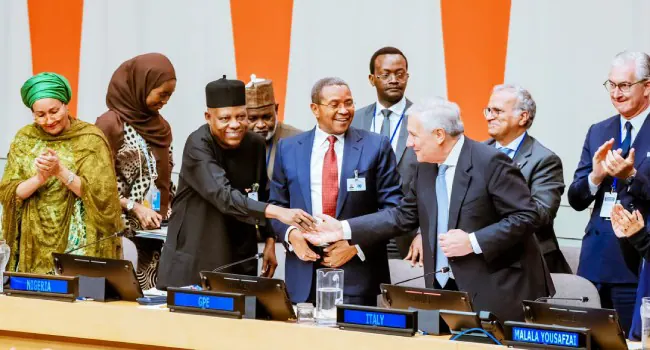
Nigeria and Italy have joined forces to support a global education financing campaign, with Italy pledging €50m towards the Global Partnership for Education's programmes and interventions. The two countries co-hosted a high-level event on the sidelines of the 81st session of the United Nations General Assembly in New York, seeking to mobilise $5bn for education in developing countries. This initiative aims to improve access to learning and educational outcomes in countries facing significant challenges.
Nigerian Vice-President Kashim Shettima represented President Bola Tinubu at the UN gathering, where he emphasised the importance of education as an investment in economic growth, productivity, and national stability. Shettima stated that education was not merely an area of government expenditure but a vital investment in Nigeria's economic future and the prosperity of its people. The Tinubu administration has reportedly increased resources for education and implemented reforms to strengthen basic education financing and access to tertiary and technical education.
The Nigerian government has launched several initiatives to widen access to higher education, including the Nigerian Education Loan Fund. According to Shettima, President Tinubu has directed that recovered liquid funds be channelled to the student loan scheme, once legally cleared. The Federal Executive Council has also approved consideration of unclaimed dividends and dormant funds for the same purpose, subject to legal requirements. These efforts aim to strengthen links between education, skills, and employment.
Nigeria's partnership with the World Bank and the Global Partnership for Education through the HOPE-EDU programme is expected to benefit about 29 million children and 500,000 teachers. The $5bn GPE campaign, co-hosted by Nigeria and Italy, seeks to complement domestic education spending and attract additional financing for participating countries. Shettima stressed that domestic resources must remain the anchor, complemented by development assistance, concessional finance, philanthropy, and innovative financing.
The Global Partnership for Education's financing campaign aims to mobilise $5bn and attract an additional $10bn in co-financing for education programmes. Italy's pledge of €50m was announced at the New York event, where governments and donors also made commitments to support the education of hundreds of millions of children. The event highlighted the need for stronger international cooperation and greater attention to gender equality and the educational needs of girls, particularly in developing countries.
UN Deputy Secretary-General Amina Mohammed urged international financial institutions to help countries create the fiscal space required to improve education, including greater investment in teacher training. Education activist Malala Yousafzai also called for stronger international cooperation and greater attention to the educational needs of girls. The high-level event demonstrated the commitment of governments and development partners to addressing the global education crisis.
The Global Partnership for Education's campaign is a significant step towards addressing the global education crisis, with a focus on improving access to learning and educational outcomes in developing countries. The initiative has garnered support from governments, development partners, and activists, highlighting the need for collective action to ensure that all children have access to quality education.
Key points
- Nigeria and Italy co-hosted a high-level event to mobilise $5bn for global education financing.
- Italy pledged €50m towards the Global Partnership for Education's programmes and interventions.
- The $5bn GPE campaign aims to complement domestic education spending and attract additional financing for participating countries.