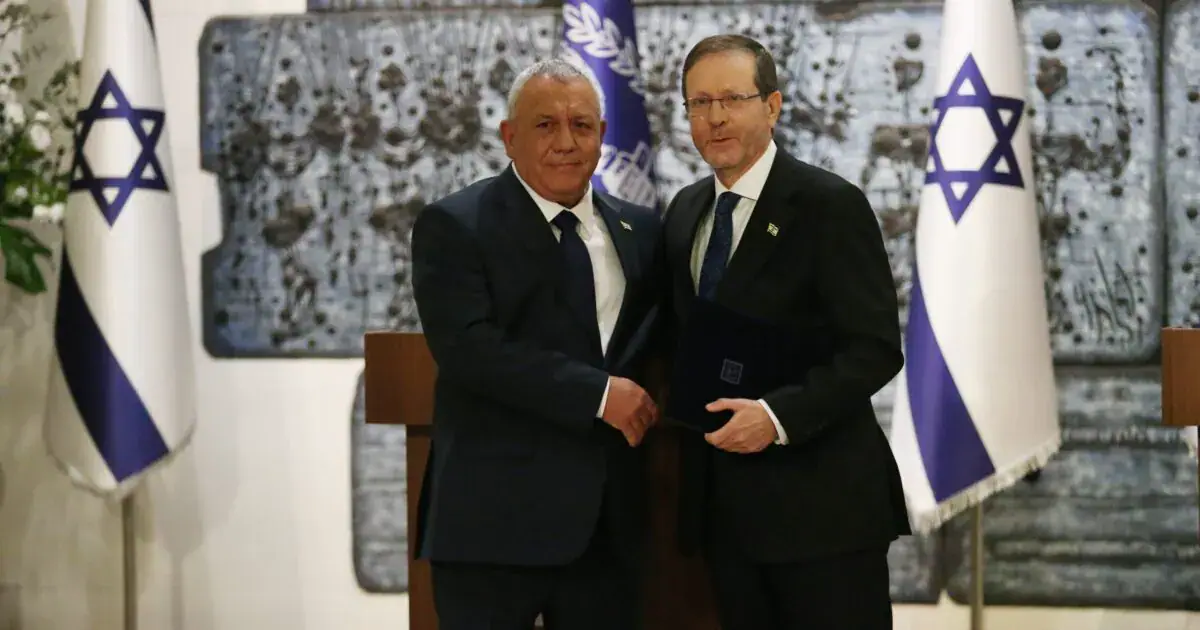
Israeli President Isaac Herzog formally tasked Gadi Eisenkot with forming the next government on Sunday, November 8, at a ceremony in Jerusalem. This move comes nearly two weeks after Israel's national election on October 27. Eisenkot, leader of the Yashar Party, was recommended by a majority of parliamentary factions as the next prime minister. Herzog expressed his expectations for Eisenkot to form a government that serves all of Israel's people.
During the televised ceremony, Herzog emphasized the importance of a responsible and decent government for all sectors, faiths, and worldviews. Eisenkot has up to six weeks to assemble a coalition, requiring at least 61 seats out of 120 in Israel's Parliament, the Knesset. If he fails, the president can give another Knesset member the opportunity to form a government. Eisenkot stated that Israeli democracy is at a vulnerable moment.
Eisenkot expressed concerns about the legitimacy of Israeli democracy and growing distrust in state institutions. He warned that continuing on this path could lead to a point of no return. However, he noted that consultations revealed an absolute majority of Knesset members support change and him as prime minister. A total of 67 members of the Knesset recommended Eisenkot, while 46 recommended incumbent Prime Minister Benjamin Netanyahu.
One faction, United Torah Judaism, with seven members of Knesset, refrained from recommending any candidate. Herzog stated that the consultations brought to the surface disputes and painful points within Israeli society and politics. He emphasized that every citizen of Israel has an equal voice, regardless of their side, view, or faith. The president's comments highlighted the challenges of forming a government in a divided society.
Eisenkot aims to bridge the divisions and form a national emergency government, even if it requires creative and unconventional initiatives. He invited elected parties and individual members of Knesset to join him in setting up the next government. Eisenkot stressed that Israel cannot afford delay or another cycle of endless elections. His efforts will focus on building a coalition that represents the diverse voices within Israeli society.
The task ahead of Eisenkot is significant, given the complexities of Israeli politics. He must navigate the competing interests and demands of various factions to form a stable government. The success of his efforts will depend on his ability to build trust and find common ground among the different groups. The outcome will have a significant impact on Israel's future.
The international community is watching closely as Eisenkot attempts to form a government. The stability of the region depends on a functional and effective Israeli government. Eisenkot's success will be crucial in determining the course of Israeli politics and its relationships with neighboring countries. The coming weeks will be critical in shaping the future of Israel.
Key points
- Gadi Eisenkot has up to six weeks to assemble a coalition of at least 61 seats in the Knesset.