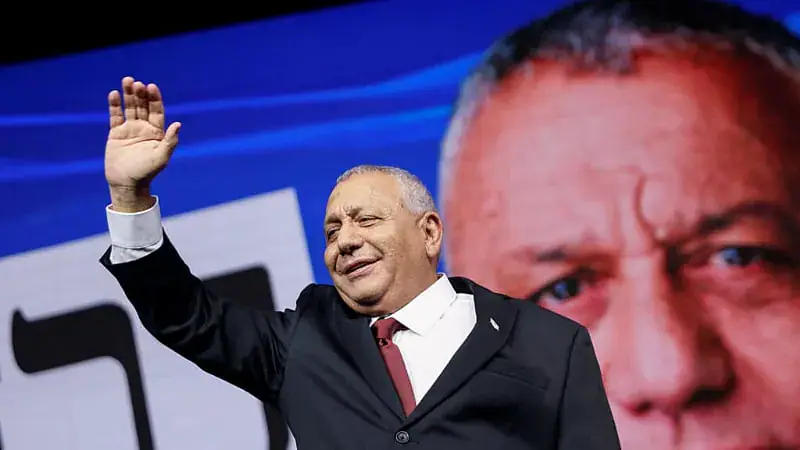
Israeli President Isaac Herzog has nominated Gadi Eisenkot, leader of the Yashar party and a strong rival of Prime Minister Benjamin Netanyahu, to form a new government. This development comes after a recent election that left no clear path to power for either Netanyahu or Eisenkot. With 28 days to form a government, Eisenkot faces significant challenges in forging a coalition. His potential pathways include forming a minority government with Arab support, a coalition with ultra-Orthodox parties, or a unity government with Netanyahu.
The recent election saw Netanyahu's Likud party win the most seats with 27 in the 120-seat Knesset, but his religious-nationalist coalition garnered only 53 seats, short of a majority. Eisenkot's Yashar party emerged as the second-largest party with 21 seats, and his coalition won 48 seats. Two parties representing Israel's Arab minority won 19 seats, a significant increase. Eisenkot, a former military chief, has publicly rebuked Netanyahu over his leadership and has vowed not to serve in government with him.
Eisenkot's nomination is seen as a long shot, with analysts suggesting that his options for forming a government are unlikely to succeed. If he fails, another candidate can try to form a government, and if that candidate also fails, parliament can nominate another. There is a deadline of around 100 days for the process, after which another election may be held. Eisenkot's public standing is tied to his security credentials, citing his "Dahiyeh doctrine" of responding to attacks with disproportionate force.
The "Dahiyeh doctrine" was deployed by Eisenkot during Israel's 2006 war with Hezbollah in Lebanon. The doctrine involves Israel vowing to use massive force against civilian infrastructure in areas controlled by Hezbollah. This approach has been adopted again in Gaza, causing significant destruction and criticism from human rights groups. Eisenkot has also criticized settler violence against Palestinians in the Israeli-occupied West Bank, decrying recent outbreaks as "Jewish terror" abetted by Netanyahu's government.
Eisenkot, 66, would be Israel's first prime minister from the Mizrahi community, Jews who trace their roots to the Middle East and North Africa. He only entered politics in 2022 and briefly served in Netanyahu's wartime cabinet before returning to the opposition. His family has paid a personal price for his involvement in politics, with a son and two nephews killed fighting in Gaza.
The Arab parties, who could potentially support Eisenkot, have expressed anger over Netanyahu's policies, which they view as racist. Despite this, Eisenkot has refused to join forces with them, citing his opposition to Netanyahu's far-right coalition partners. Herzog's decision to nominate Eisenkot is seen as a significant development, given the country's ongoing political deadlock.
As Eisenkot begins his efforts to form a government, he faces significant challenges, including opposition from Netanyahu and his allies. His success will depend on his ability to forge a coalition that can command a majority in the Knesset. If he succeeds, it would mark a significant shift in Israeli politics, with implications for the country's future direction.
Key points
- Eisenkot has 28 days to form a government, with a possible 14-day extension.
- Eisenkot's Yashar party emerged as the second-largest party with 21 seats.
- Eisenkot has criticized Netanyahu's leadership and vowed not to serve in government with him.