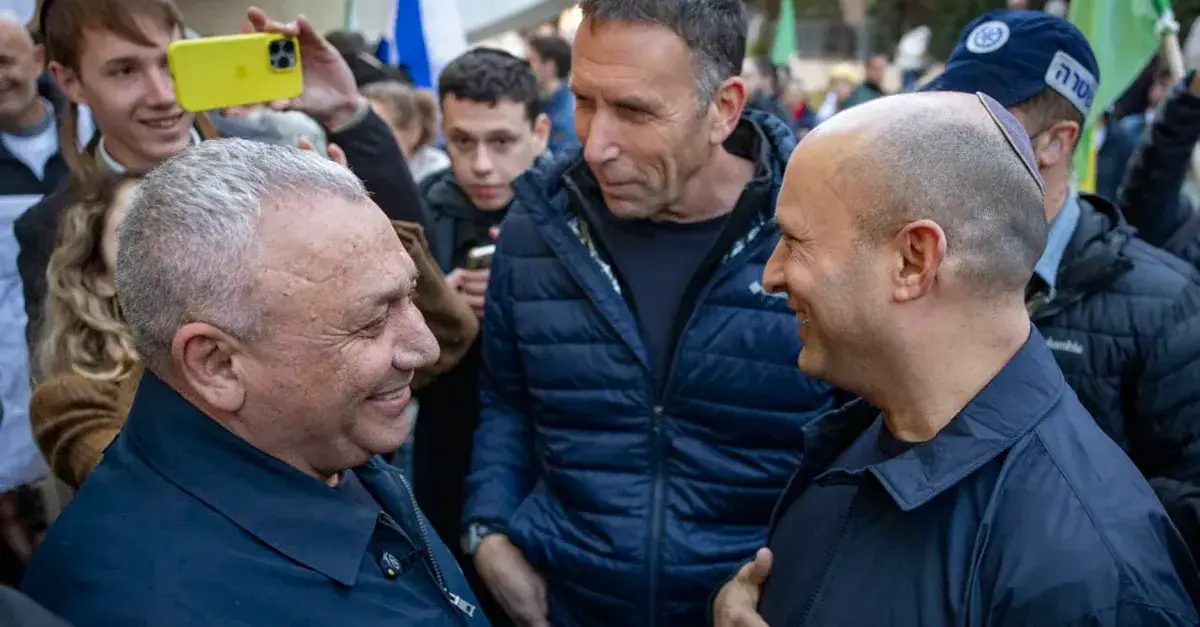
In a significant development, former Israeli Prime Minister Naftali Bennett announced that his party, "Together," will recommend Gadi Eisenkot, leader of the "Yashar" party, to form the next government. This move comes after the final results of the October 27 elections showed Netanyahu's bloc securing 53 seats, while the opposition parties garnered 48 seats, and Arab parties won 19 seats. Bennett emphasized that he will respect the voters' decision.
Eisenkot's chances of forming a government have been bolstered by Bennett's endorsement, as "Together" secured 12 seats. With "Yashar" being the largest opposition party with 21 seats, Eisenkot is well-positioned to negotiate with other parties. However, he faces challenges in building a coalition, particularly with Arab parties, due to disagreements within the opposition camp. Yair Golan, leader of the Democratic party, stressed the need for a new government, highlighting that the opposition parties can gather 48 seats without Arab parties, rising to 56 seats with the potential inclusion of the "Rahaman" party.
The Arab parties, which achieved a record 19 seats, are seeking to capitalize on their increased representation. Youssef Jabareen, leader of the Joint List, stated that any party seeking to replace Netanyahu's government must engage with him. He emphasized that the Arab parties' significant representation makes them a force that cannot be ignored. Jabareen called for a Jewish-Arab partnership to end what he described as racist and exclusionary policies.
However, not all opposition parties are willing to work with Arab parties. Avigdor Lieberman, leader of "Israel Beytenu," reiterated his refusal to join a government that relies on Arab parties, citing their alleged support for terrorism. This stance poses a challenge to Eisenkot, who must navigate the complex relationships between various parties. Moshe Yaalon, former Defense Minister, suggested that the opposition parties should form a government with "Rahaman" and even offered to grant its leader, Mansour Abbas, a ministerial position.
The opposition parties are also seeking to assert their influence within the Knesset. Reports indicate that they have reached an understanding with the Joint List and "Rahaman" to oust the current Knesset Speaker, Amir Ohana, and replace him with a new speaker. This move is expected to take place after the new Knesset is sworn in on November 10. Yair Golan hinted that the opposition may also push for the establishment of a state commission to investigate the government's handling of the October 7 attacks.
The elections themselves have been marred by controversy, with Netanyahu accusing external forces of interfering in the voting process, particularly in the Arab community. In response, the Central Elections Committee has launched an investigation into allegations of foreign funding and irregularities. Committee head, Noam Solberg, emphasized that the probe is based on classified intelligence and that the results of the elections reflect the will of the voters.
As the opposition parties continue to jockey for position, Gadi Eisenkot has announced the appointment of Roy Folkman as head of the "Yashar" party's Knesset faction. This move signals the party's preparations for coalition negotiations and its role in the opposition. The coming days will be crucial in determining whether Eisenkot can successfully form a government and bring an end to Netanyahu's tenure as Prime Minister.
Key points
- The opposition parties are closing in on forming a new government, with Gadi Eisenkot emerging as a potential candidate for prime minister.
- The Arab parties' increased representation has made them a key player in the negotiations, with some parties willing to work with them and others opposed.
- The investigation into election irregularities and foreign interference has added to the complexity of the situation, with the opposition parties seeking to capitalize on the controversy.