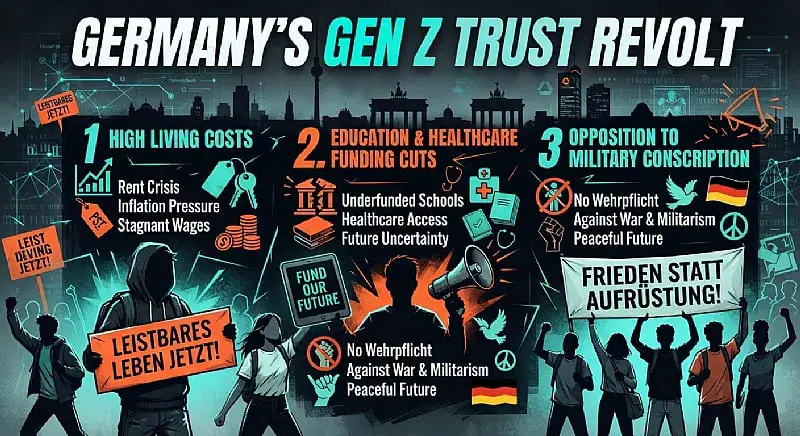
Germany's recent youth protests, which saw thousands take to the streets in over 30 cities, have highlighted a growing trust crisis in the country's political institutions. The protests, which began peacefully during the day, turned violent at night, with looting and attacks on police reported in several city centres. According to a new assessment, the protests were driven by young people's frustration over issues like living costs, schools, social protection, and climate policy.
The study, which analysed the protests and their underlying causes, found that young Germans have very low latent public trust, with a score of 30 out of 100, and a deep youth representation gap. The study also found that trust in the police and courts is far stronger than trust in the Bundestag or political parties. This suggests that the problem is not a rejection of the state itself, but rather a concentration of distrust in the political-representative layer.
The protests were about more than one issue, with organisers calling for investment in education, social security, health, and affordable living, as well as school funding, addiction support, and psychotherapy. They also opposed conscription and surveillance and demanded a greater say in decisions affecting their lives. The study identified ten strategic issue clusters, with the top three being the cost of living and affordability, schools and education, and government responsiveness.
The study found that trust on the cost of living is rated at 24/100, on school investment at 20/100, and on government responsiveness at just 18/100, each paired with a risk score above 80. This suggests that young people are deeply concerned about whether political institutions are responsive to their needs. UNICEF Germany reports that around 80% of 14-to-17-year-olds say politicians do too little for them.
The study also cited rising indebtedness among young people and persistent concerns about schools and mental-health provision. For a country facing demographic pressure and reliant on a highly skilled workforce, these signals matter beyond protest politics. If young people come to see emigration, disengagement, or radical alternatives as more credible than participation, the cost will show up in lost talent, weaker social cohesion, and declining confidence in democratic responsiveness.
Germany's political institutions are not failing equally, with citizens maintaining confidence in the courts, police, and democracy as a principle, while expressing deep dissatisfaction with the government, parties, and parliamentary representation. The sharpest fracture runs between citizens and the political institutions responsible for representation, performance, and policy delivery.
The study's findings have significant implications for Germany's policymakers, who must respond to the grievances of young people without allowing disorder to define the protests. The study warns that a security-only response could deepen the very distrust driving the protests. Instead, policymakers must address the underlying issues of trust, responsiveness, and representation.
Key points
- Young Germans have very low latent public trust, with a score of 30 out of 100.
- The protests were driven by frustration over issues like living costs, schools, social protection, and climate policy.
- The study warns that a security-only response could deepen the very distrust driving the protests.