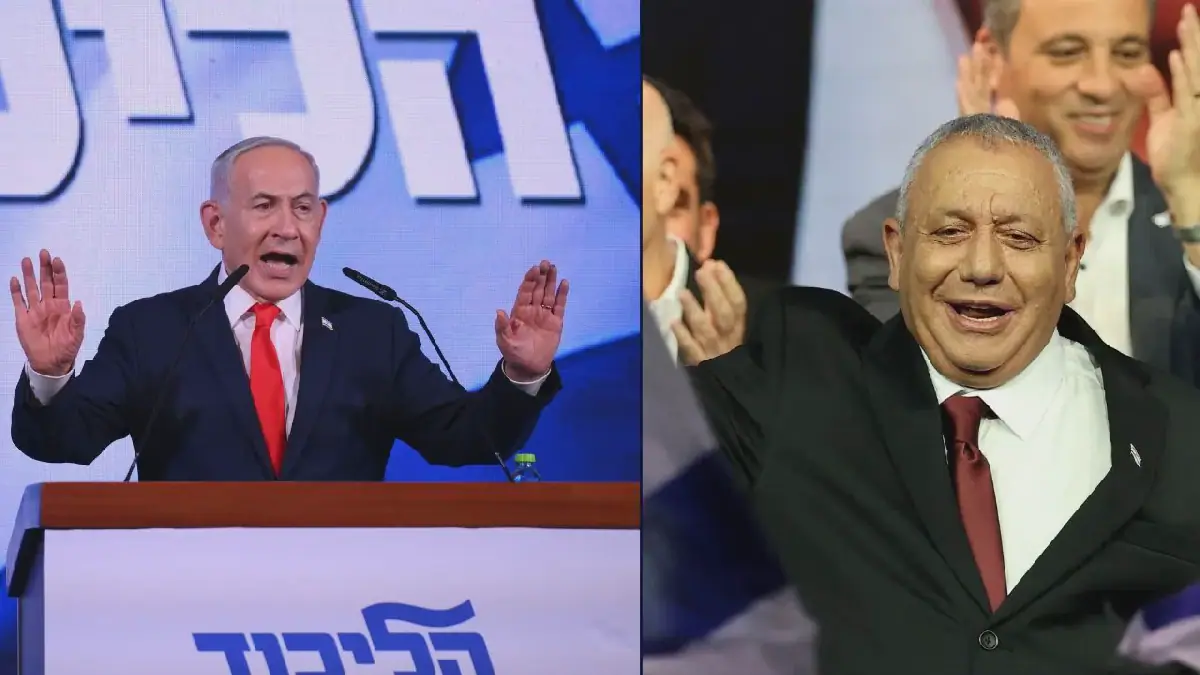
The Israeli opposition bloc, led by centrist Gadi Eisenkot, convened on Tuesday to discuss forming a majority government following the October 27 elections, which yielded no clear winner. The bloc's parties will meet to coordinate their next steps, according to a statement by Eisenkot's Yashar party. This marks their first meeting since the elections, which saw Netanyahu's coalition secure 53 seats and Eisenkot's bloc obtain 48 seats.
The main question surrounding the opposition bloc is the role it will assign to the Arab lists, Raam and the Unified List, which secured a record 19 seats in the 120-seat parliament. All components of the bloc have stated they will propose Eisenkot as the future prime minister to President Isaac Herzog. The Arab parties have also hinted at supporting Eisenkot's candidacy.
In contrast, Netanyahu has called for a broad coalition government under his leadership, excluding Arab parties, which he has repeatedly targeted during and after the campaign. Netanyahu's Likoud party has described these parties as a threat to Israel's survival. The Arab parties' leaders have characterized Netanyahu's government as "racist."
Netanyahu has expressed openness to dialogue with potential coalition partners, stating he seeks a broad government with partners that do not support terrorism. However, he emphasized that the Israeli public does not want a government dependent on Raam and the Unified List, accusing these parties of supporting terrorism and denying the existence of the Jewish state.
Within the opposition bloc, opinions are divided regarding an alliance with the Arab parties. Left-wing leader Yaïr Golan supports such an alliance, while right-wing leader Avigdor Liberman strongly opposes it. The position of the Center Party, Ensemble, remains unclear.
President Herzog will consult with the parties from Wednesday to Thursday, starting with those that secured the fewest seats. Based on the election results, Herzog is expected to task the most recommended candidate with forming a government, with Eisenkot appearing to be the frontrunner. Netanyahu's allies, Bezalel Smotrich and Itamar Ben Gvir, are likely to propose Netanyahu's name.
The process of forming a government has a set timeline, with Herzog having until November 11 to make his decision. The designated candidate will then have 28 days, extendable by 14 days, to form a coalition that can secure a parliamentary majority. If this process fails, the president can assign the task to another candidate or return it to the parliament.
Key points
- Netanyahu pushes for a coalition government excluding Arab parties
- Opposition bloc supports Gadi Eisenkot as the next prime minister
- Arab parties may play a crucial role in forming the next government