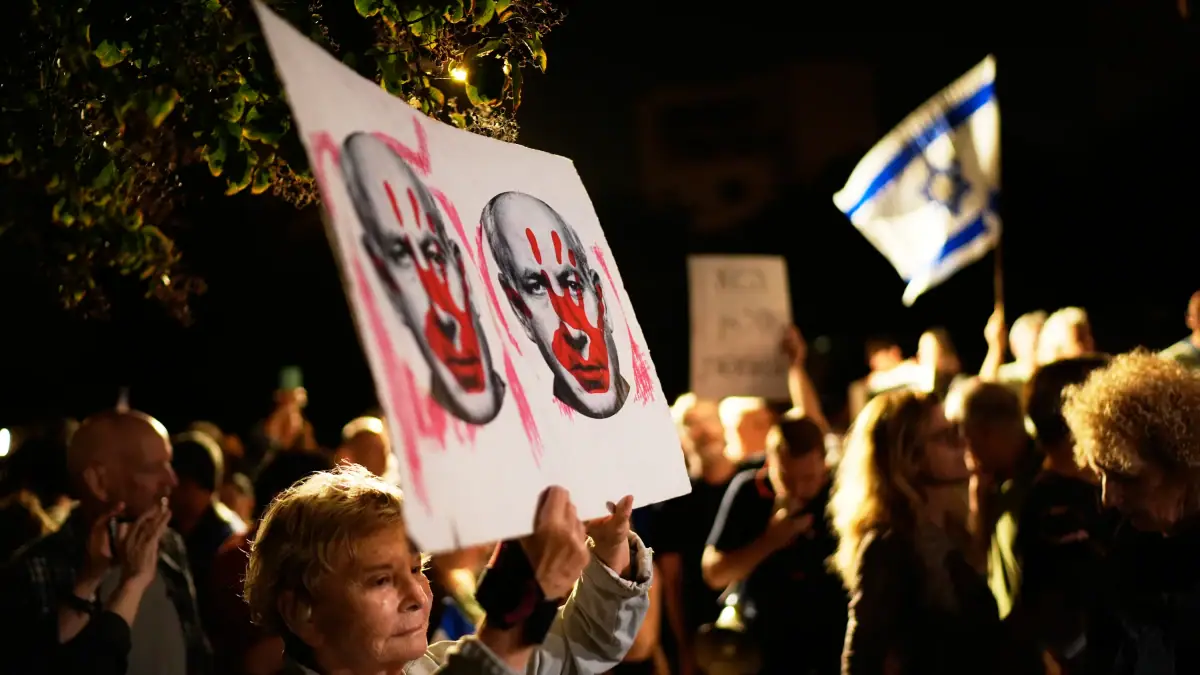
Israel's recent election has resulted in a political stalemate, with the final results showing that opposition parties have more seats than Netanyahu's right-wing bloc. However, Eisenkot, a center-right former military chief of staff, cannot form a governing majority without the support of predominantly Arab parties, an option his allies have repeatedly ruled out.
The Likud party, led by Netanyahu, received the most votes, but his bloc falls short of a majority. The coalition of right-wing, far-right, and ultra-Orthodox parties that supported his previous government does not control the required 61 seats in Israel's 120-seat parliament, known as the Knesset.
In the coming days, Israel's president will consult with the leaders of every party elected to parliament, and each party will recommend the party leader it believes should be given the first opportunity to form a coalition. The president will then select the candidate considered most likely to assemble a governing coalition, who will have 28 days to secure the support of at least 61 lawmakers.
Based on the election results, Eisenkot appears more likely than Netanyahu to receive the largest number of recommendations from newly elected lawmakers. However, Eisenkot's political bloc lacks a majority without the Arab-led parties, and he has repeatedly promised not to form a coalition that depends on their support.
Several possible outcomes have emerged, including a unity government bringing together Netanyahu and Eisenkot, which would likely include more moderate parties from Israel's political center and right. Another possibility is an Eisenkot government supported by Arab parties, which would command a comfortable parliamentary majority but remains unlikely due to Eisenkot's campaign promises.
A third possibility is another election, which Israel's president has urged against, particularly after an election that drew the highest turnout in decades. Netanyahu may believe a repeat election could work in his favor, as Arab turnout could decline if Arab voters conclude that the predominantly Jewish opposition parties will not allow their representatives to participate in government.
During this stalemate, the opposition could undermine Netanyahu by advancing legislation before a new government is formed, with support from Arab lawmakers. Eisenkot's bloc is considering an effort to replace the speaker of the Knesset and pass legislation establishing a state commission of inquiry into the political and security failures that preceded the Hamas-led attack on Israel on Oct 7, 2023.
Key points
- The opposition may try to pass legislation to establish a state commission of inquiry into the political and security failures that preceded the Hamas-led attack on Israel.
- A unity government between Netanyahu and Eisenkot is a possible outcome.
- Another election remains a possibility if no candidate can assemble a majority.