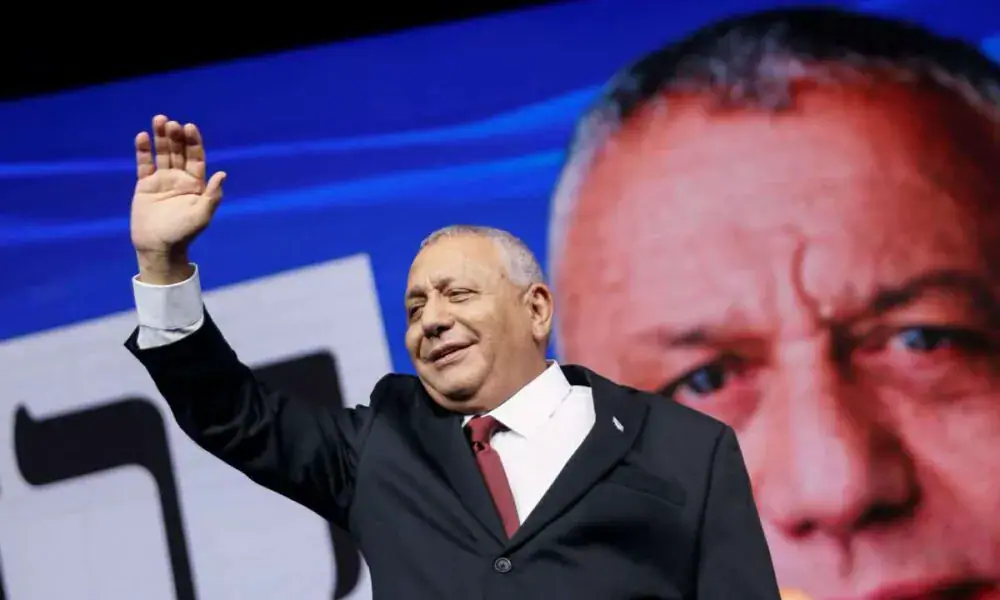
Israel's President Isaac Herzog has chosen former military chief Gadi Eisenkot to form the country's next government, snubbing incumbent Prime Minister Benjamin Netanyahu. This decision comes after last month's general election on October 27 failed to produce a clear parliamentary majority. Herzog made the announcement on Saturday evening, with a formal presentation of the mandate scheduled for Sunday.
Eisenkot, who leads the Yashar party, secured the backing of 67 lawmakers, including representatives of Arab-led parties. In contrast, Netanyahu received recommendations from 46 legislators. Under Israel's parliamentary system, Eisenkot has 28 days to assemble a governing coalition, with the option of an additional 14 days if necessary. To succeed, any coalition government must secure the support of at least 61 members of the 120-seat Knesset.
Eisenkot's four-party alliance emerged from the election with 48 seats, while Netanyahu's right-wing and religious coalition secured 53. However, both fell short of the 61 seats required to command a parliamentary majority. The Arab-led parties, representing Palestinian citizens of Israel, recorded a historic performance, winning a combined 19 seats. Despite receiving their support, Eisenkot has ruled out forming a formal coalition with the Arab-led parties.
To achieve the required 61 seats, Eisenkot may seek the support of the two ultra-Orthodox parties, United Torah Judaism and Shas. Another possibility is for him to establish a minority government that survives through parliamentary support from lawmakers outside the coalition, provided it secures the necessary confidence vote.
If Eisenkot fails to put together a government within the stipulated period, Herzog can nominate another candidate. Should the second nominee also fail, a majority of lawmakers may recommend a third candidate, who would have a final 14 days to form an administration. Failure at that stage would trigger another general election within 90 days, with Netanyahu remaining in office in a caretaker capacity.
Eisenkot, a former Israel Defence Forces chief of staff who served from 2015 to 2019, was also an observer in Netanyahu's war cabinet during the first eight months of Israel's military campaign in Gaza, which began in October 2023. His nomination has received support from Arab-led political groups, largely united by their opposition to another Netanyahu-led administration.
Ahmad Tibi, a senior member of the Joint List, a coalition of Arab-led parties with 11 seats, described Herzog's decision as expected. With this development, Eisenkot faces the challenge of forming a viable government within the given timeframe, while Netanyahu's prospects of regaining power remain uncertain.
Key points
- Eisenkot has 28 days to assemble a governing coalition, with the option of an additional 14 days if necessary.
- Eisenkot's four-party alliance has 48 seats, falling short of the 61 seats required for a parliamentary majority.
- Arab-led parties won a combined 19 seats, a historic performance, but Eisenkot has ruled out a formal coalition with them.
Reporting sources
- Israel president chooses Eisenkot over Netanyahu to form next government · Business Hallmark