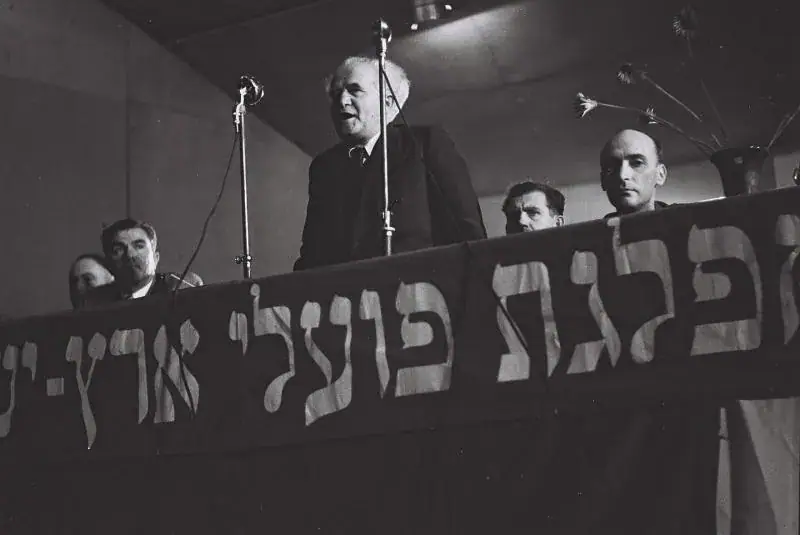
In January 1949, Israel, a country just eight months old, held its first legislative elections. The country was still at war, with fighting ongoing in the Holy Land, but the elections marked a significant step towards establishing a functional parliamentary state. Over 430,000 Israelis, out of 506,000 registered voters, participated in the elections, with a turnout of 86.9%. This was a remarkable achievement, especially given the country's state of war.
The elections resulted in the Mapai party, led by David Ben-Gourion, winning 46 seats in the 120-member Constituent Assembly, which would later be renamed the Knesset. The party secured 35% of the vote, while the Mapam party, a left-wing socialist party, won 19 seats with 14% of the vote. The Front Religieux Uni, a unified religious bloc, secured 16 seats, and the Herout party, led by Menahem Begin, won 14 seats.
The elections were seen as a crucial test of Israel's democratic institutions, with the country still reeling from the aftermath of the 1948 Arab-Israeli War. The Knesset, which first convened on February 14, 1949, in Tel Aviv, comprised 117 Jewish and 3 Arab members, including 12 women. The assembly's composition reflected the country's diverse population and marked a significant step towards establishing a representative government.
The election results had significant implications for Israel's future. Ben-Gourion's Mapai party did not secure an absolute majority, necessitating coalition talks with other parties. The party's leaders were expected to decide whether to form an alliance with the Mapam party, their left-wing rivals, or to seek support from the Front Religieux Uni, a more conservative bloc.
The elections also highlighted the country's ongoing challenges, including the absorption of hundreds of thousands of Palestinian refugees and the need for international recognition. The Knesset's first task was to draft a constitution and establish a functional government, which would require cooperation among various parties.
The Communist Party, which had secured 2.6% of the vote, was expected to have between six and nine seats in the Knesset. The party's support base was largely drawn from Arab voters, with one of its two deputies expected to be a Muslim. The opposition Herout party, led by Menahem Begin, was also left disappointed, having failed to make significant gains.
The election outcome set the stage for Ben-Gourion's leadership and the development of Israel's government. As the country's first prime minister, Ben-Gourion faced significant challenges, including navigating the complexities of coalition politics and addressing the country's pressing social and economic needs.
Key points
- The 1949 Israeli elections marked a significant milestone in the country's transition to a parliamentary democracy.
- David Ben-Gourion's Mapai party emerged as the largest party, winning 46 seats in the Constituent Assembly.
- The elections took place amidst ongoing conflict and uncertainty, with the country still reeling from the 1948 Arab-Israeli War.