Ghana has made significant strides in protecting children online, with the implementation of the Cybersecurity Act, 2020 (Act 1038), which criminalizes key forms of online child sexual exploitation. The National Child Online Protection Framework provides an architecture for protection, and various organizations, including UNICEF Ghana, CHRAJ, and the Ghana Police Service, are contributing to the effort. However, the question remains whether these efforts are sufficient to combat the growing threat of online child exploitation.
The digital world has become an integral part of childhood, with social media platforms, online learning tools, and gaming sites becoming increasingly popular among children. This has created new vulnerabilities, as predators can now easily target children online, and traditional child-protection systems are struggling to keep pace. Ghana's current systems were designed for physical spaces, and there is a need to adapt these systems to the digital environment.
Awareness-raising efforts are necessary but insufficient to protect children online. Simply telling children to "be careful" or parents to "monitor more" places a heavy burden on those least equipped to defeat sophisticated offenders. A child can understand grooming and still be groomed, and a parent can recognize cyberbullying but not know where to turn when their child is being blackmailed. A comprehensive protection chain is needed, including prevention, detection, reporting, response, investigation, prosecution, and recovery.
Ghana needs a complete protection chain to effectively combat online child exploitation. This requires a whole-of-society responsibility, with every link in the chain crucial to the system's success. If reporting works but investigation does not, the system fails. If investigation occurs but survivors receive no psychological or social support, the system fails. The government, schools, technology companies, and civil-society organizations all have a role to play in protecting children online.
A key challenge facing Ghana is the lack of data on the effectiveness of its current systems. Without data on the number of reports received, response times, and outcomes, it is difficult to measure the impact of current efforts. A thousand awareness sessions mean little if a child who reports abuse cannot obtain timely help. To address this, Ghana should build a connected National Child Online Protection System, linking existing institutions and programs through clear referral pathways and shared accountability.
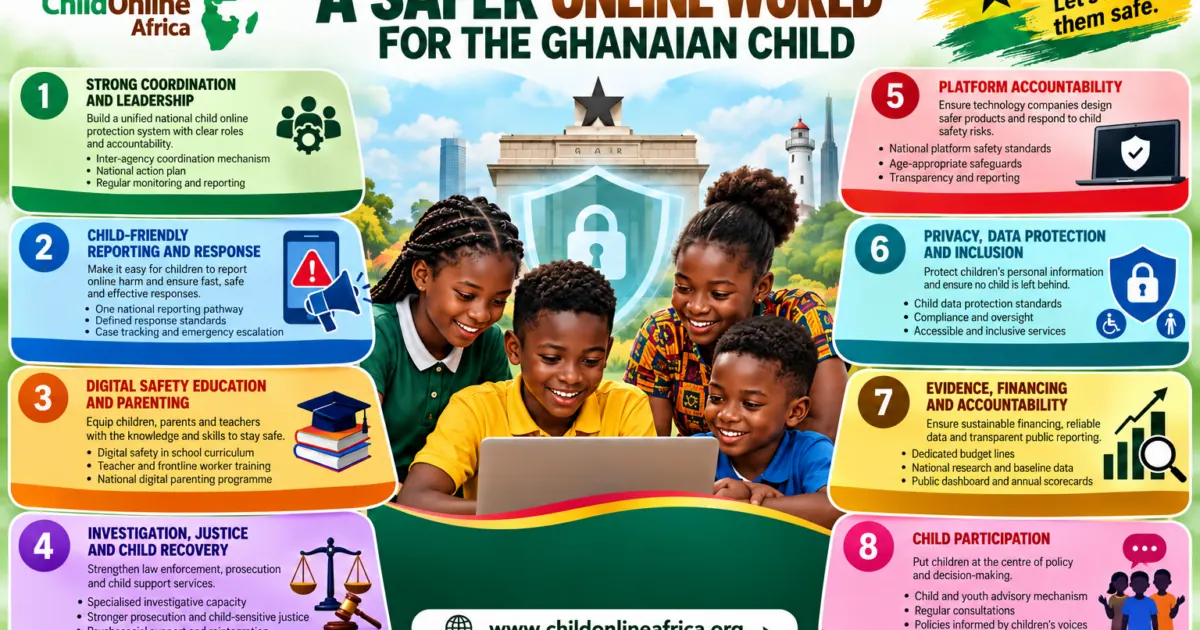
A practical 12-month agenda has been proposed, focusing on eight priorities, including establishing a single national referral pathway, creating a national child online safety dashboard, and integrating digital safety into mainstream education. Technology companies operating in Ghana will also be required to demonstrate concrete child-safety measures. By working together, Ghana can build a comprehensive system to protect children online.
Ultimately, protecting children online requires a collaborative effort from all stakeholders, including government, schools, technology companies, and civil-society organizations. Children themselves must be partners in the process, not just subjects of protection. By working together and sharing responsibility, Ghana can ensure that children are protected from online exploitation and can safely navigate the digital world.
Key points
- Ghana needs to build a complete protection chain to effectively combat online child exploitation.
- A connected National Child Online Protection System is needed to link existing institutions and programs.
- Technology companies operating in Ghana must demonstrate concrete child-safety measures.