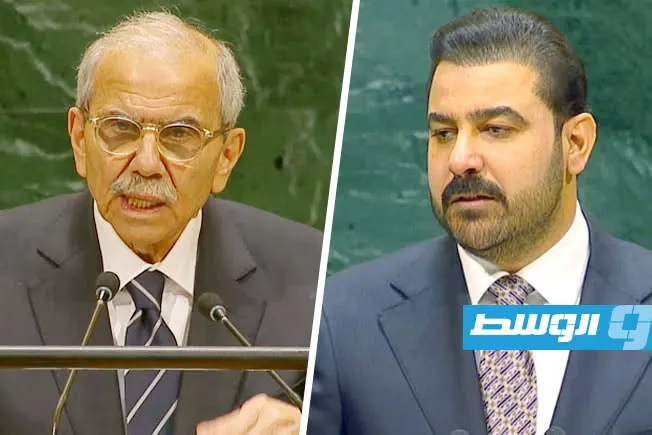
On September 25, 2026, Iraqi Prime Minister Ali Al-Zaydi and Lebanese Prime Minister Nawaf Salam addressed the UN General Assembly in New York. Both leaders emphasized the need for state control over military force and decision-making on war and peace. This statement comes amid growing international pressure, particularly from the US and Israel, to disarm Iraqi factions and Lebanon's Hezbollah.
Prime Minister Salam highlighted the importance of state control over military force and decision-making, citing Lebanon's experience of being drawn into a war it did not choose. He stressed that Lebanon's future should not be decided on its behalf and that its security and stability should not be used as a bargaining chip. Salam also noted that Lebanon's cabinet has taken decisions to address this issue.
Prime Minister Al-Zaydi echoed Salam's sentiments, emphasizing that Iraq's priority is for the state to have control over decision-making on war and peace, with military force and tools of power in the hands of its constitutional institutions. He stated that the rule of law and national interest should guide Iraq's decision-making. Al-Zaydi also noted that Iraq is taking steps to implement this vision, which he believes is essential for building a state based on institutions and protecting its sovereignty.
The statements by Al-Zaydi and Salam reflect the concerns of their countries about the potential risks of uncontrolled military force and the importance of state authority. Both leaders emphasized that their countries will not allow external actors to dictate their decisions on war and peace. This stance is likely to be seen as a challenge to international pressure, particularly from the US and Israel.
The issue of state control over military force is a contentious one in the region, with many countries facing pressure to disarm various factions and militias. Iraq and Lebanon are no exceptions, with both countries having complex relationships with various armed groups. The statements by Al-Zaydi and Salam suggest that they are committed to establishing a strong state that can exercise control over its territory and make decisions on war and peace.
The UN General Assembly provides a platform for world leaders to discuss pressing global issues, including conflict, security, and state sovereignty. The statements by Al-Zaydi and Salam reflect the concerns of their countries about the impact of external pressure on their sovereignty and stability. The Assembly's discussions are likely to continue to focus on these issues, with many countries facing challenges in maintaining control over their territory and making decisions on war and peace.
In conclusion, the statements by Iraqi Prime Minister Ali Al-Zaydi and Lebanese Prime Minister Nawaf Salam at the UN General Assembly emphasize the importance of state control over military force and decision-making on war and peace. Their statements reflect the concerns of their countries about the potential risks of uncontrolled military force and the importance of state authority.
Key points
- Iraq and Lebanon stress the importance of state control over military force and decision-making on war and peace at the UN General Assembly.