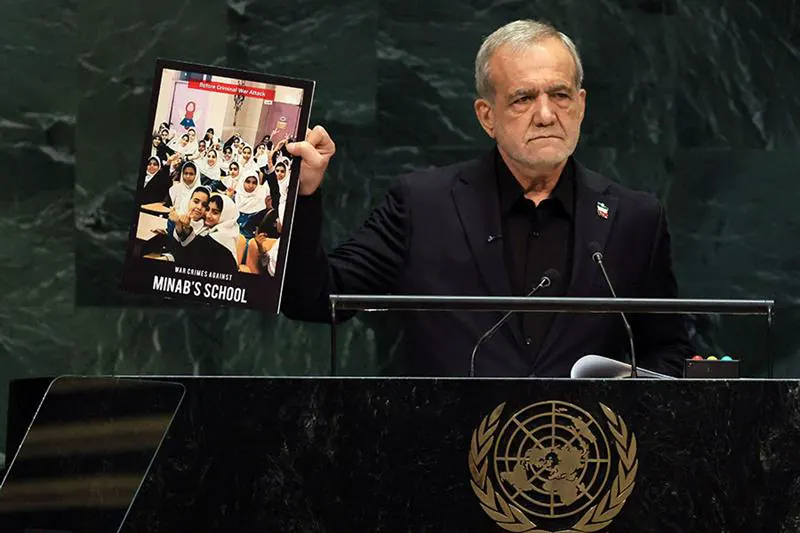
Iranian President Massoud Pezeshkian delivered a defiant speech at the United Nations General Assembly on Wednesday, September 23, 2026, stating that his country would never back down in the face of US aggression. He accused the US of perpetrating "terrorism" against Iran and emphasized that the Iranian people's resistance would only intensify in response to sanctions and pressure. This marked the first time a high-ranking Iranian official had visited the US since the war began.
The speech was a direct response to US President Donald Trump's address to the UN on Tuesday, in which he threatened to "annihilate" Iran. Pezeshkian asserted that Iran had never been an aggressor and had never initiated a war. He also warned that Iran would not tolerate the use of the Strait of Hormuz for aggression against his country. The Strait of Hormuz, a crucial waterway for global oil transit, has been a focal point of the conflict between Iran and the US.
Despite the aggressive rhetoric, both sides have engaged in diplomatic efforts. US envoy Steve Witkoff revealed that Iranian and American officials had talks via mediators on the sidelines of the UN General Assembly. These developments occur against the backdrop of heightened tensions in the Middle East, with the conflict affecting global energy prices. The Houthis, backed by Iran, have consolidated their control of the Bab el-Mandeb strait, further escalating regional tensions.
The conflict has significant economic implications, with the US imposing a blockade on Iranian ports and increasing economic pressure on Iran. In response, Iran has disrupted traffic in the Strait of Hormuz, which previously accounted for a fifth of global hydrocarbons transit. The situation has raised concerns about the potential for further escalation and its impact on global energy markets.
The UN General Assembly also addressed other pressing issues, including the situation in Ukraine. Ukrainian President Volodymyr Zelensky attended a Security Council meeting, where he stated that Kiev and Washington wanted the war to end before winter. He expressed willingness to cease strikes on Russian energy sites if Moscow reciprocated.
The issue of artificial intelligence was also on the agenda, with the UN discussing its potential risks and implications for international security. Several countries, including France, European partners, and Canada, have called for regulation of AI, while the US and China have been hesitant to impose restrictions that might hinder their national champions in the AI sector.
On the sidelines of the UN General Assembly, Egyptian President Abdel Fattah el-Sisi met with world leaders to discuss the situation in the Middle East. Egypt has been advocating for de-escalation and a peaceful resolution to the conflicts in the region. The country has also been working to strengthen its national brands and industries, with a focus on innovation and economic development.
Key points
- Iranian President Massoud Pezeshkian vowed to resist US aggression and sanctions in a speech at the UN General Assembly.
- The conflict between Iran and the US has significant implications for global energy markets and regional stability.
- Diplomatic efforts between Iran and the US are ongoing, despite the aggressive rhetoric from both sides.