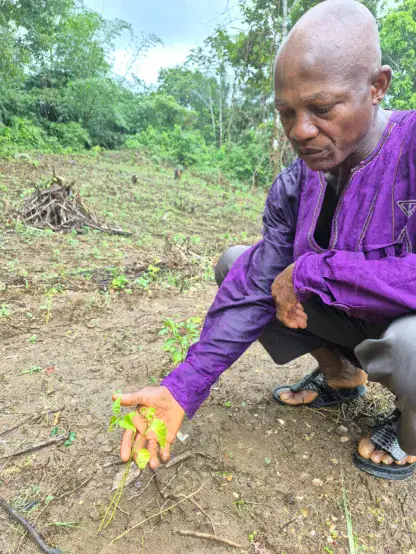
The US-Israeli war with Iran has led to a significant increase in fertilizer prices and shortages, affecting Liberia’s small farmers. Aaron Moore, a 49-year-old farmer from Careysburg, is struggling to afford fertilizer for his pepper and cucumber crops. The pale leaves on his plants are a clear indication of the problem. Moore has been farming on this plot for over four years, but now he can no longer afford the fertilizer he needs to keep his crops growing.
The crisis in the Middle East has added to fertilizer shortages and higher prices around the world, making it harder for Liberia to get supplies. Francis Mulbah, the Ministry of Agriculture’s assistant minister for planning and development, said the government provided fertilizer to rice farmers through an emergency food production program funded by the African Development Bank, which ended in 2024. The government is also in talks with OCP Africa, a fertilizer company based in Morocco, to supply fertilizer at lower prices.
The stakes are high in a country where about one in five people do not have enough food year-round and a quarter of young children are stunted, according to the World Food Programme. The government has tried to ease import costs by suspending import tariffs on farm supplies, including fertilizer, and buying fertilizer in bulk for distribution to farmers. However, those programs are shrinking as foreign aid is cut, and growers outside them must buy at market prices.
Experts say farmers across the country face the same problem. Jonathan S. Stewart, chief executive of Agrotech Liberia, said just finding a bag of fertilizer can be a challenge. Some sellers have run out, and major suppliers are based in Monrovia, so farmers in other areas must also pay for transport. The costs begin before fertilizer is even used, with small packs of cucumber seeds costing US$20 to US$25.
The high cost of fertilizer is overwhelming for farmers working small plots. Julius M. Bass, a cocoa farmer who previously led the Farmers Union Network, said those costs can be devastating. He has spent about 24 years in agriculture and has seen firsthand the problems growers face. Bass said a farmer using a hectare to grow cucumbers needs fertilizer, but how does he get the money to buy it at that kind of astronomical cost?
For Moore, the pressure is immediate. Fertilizer now costs about L$12,000 (about US$65) a bag, compared with L$9,000 to L$11,000 a few years ago. Prices tend to dip during the rainy season and rise in the dry months. That offers little comfort when he does not have the money to buy a bag. Moore said he makes about L$50,000 (about US$270) in some seasons and up to L$75,000 (about US$410) when the crop does well.
The government and experts are working to find solutions to the problem. Mulbah said fertilizer subsidies could make farm supplies more affordable. Stewart said some farmers have learned to mulch with leaves, which break down and add nutrients to the soil. However, heavy rains can wash nutrients away, and Moore said it does not work as well as fertilizer. The crisis highlights the need for sustainable solutions to support Liberia’s small farmers.
Key points
- The US-Israeli war with Iran has led to a significant increase in fertilizer prices and shortages, affecting Liberia’s small farmers.
- The government is working to ease import costs and provide fertilizer to farmers, but those programs are shrinking as foreign aid is cut.
- Experts say fertilizer subsidies and sustainable farming practices could help make farm supplies more affordable and support Liberia’s small farmers.