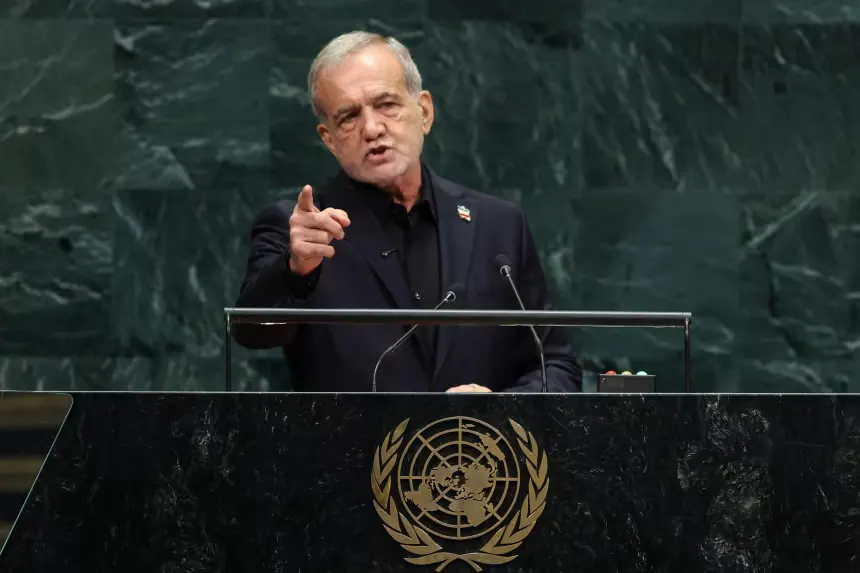
Iranian President Masoud Pezeshkian delivered a highly anticipated speech at the 81st session of the United Nations General Assembly, held on American soil. In his address, Pezeshkian told world leaders that Iran will not yield on its nuclear program, missile defenses, or control of the Strait of Hormuz, a vital waterway through which a fifth of the world's oil once flowed. He emphasized that Iran cannot allow some countries to have free access to the waterway while imposing their aggressions and insecurity upon Iran.
Pezeshkian's speech was a response to US President Donald Trump's threats of "annihilation" and mounting economic strain at home. Trump has boasted that the US has "blown up" nuclear sites in Iran and claimed control over the Strait of Hormuz. The Iranian president's address received near-unanimous praise in Iranian media, even from hardline publications. According to Pezeshkian, Trump's rhetoric caused him to rewrite the speech he had prepared before traveling to New York.
The speech was a rare historic moment, with a foreign leader holding forth in an enemy country still at war with his own. The US-Israeli war on Iran has dragged on for seven months, turning a military operation that began with the killing of the Islamic Republic's supreme leader, Ayatollah Ali Khamenei, into months of regional instability. One of Pezeshkian's key messages offered a glimpse into how the Islamic Republic seeks to set its post-war regional stance.
Pezeshkian told Iran's neighbors that its future security must be guaranteed, or the entire region will have to "live under insecurity together." This message carried an implicit threat, according to Sanam Vakil, director of the Middle East and North Africa program at London's Chatham House think tank. Vakil stated that Iran was presenting regional security as indivisible, signaling that continued pressure and conflict would impose costs across the region.
Iranian Foreign Minister Abbas Araghchi held talks with Trump's peace envoy Steve Witkoff in New York, marking the first sign of diplomacy between the two nations since an ill-fated agreement was signed more than three months ago. However, US Secretary of State Marco Rubio said those talks did not yield any major breakthrough, indicating the Memorandum of Understanding (MoU) from earlier this year was no longer on the cards.
Pezeshkian and Iranian officials who engaged in diplomatic efforts with Washington have faced scrutiny from rival hard-line factions, which regard any agreement with Trump as tantamount to surrender. Hard-line lawmaker Ebrahim Rezaei asked Foreign Minister Araghchi to explain the authorization for his meeting with Witkoff. Pezeshkian has also drawn criticism from hard-liners for attending the meeting in New York.
As Pezeshkian delivered Iran's demands to the world, security officials back home announced a more hard-line position in Iran's negotiating tactics. Iran's Supreme National Security Council chief, Mohsen Rezaei, stated that the Islamic Republic will adopt a new framework when negotiating with the US, requiring Washington to take the first step. Rezaei emphasized that any future talks or reopening of the Strait of Hormuz will be contingent upon Washington's full implementation of Iran's requirements as a precondition.
Key points
- Iran's President Masoud Pezeshkian outlined Tehran's demands at the UN General Assembly.
- Pezeshkian emphasized Iran's commitment to its nuclear program, missile defenses, and control of the Strait of Hormuz.
- The Iranian president's address received praise in Iranian media, and his diplomatic efforts have sparked scrutiny from hard-line factions.