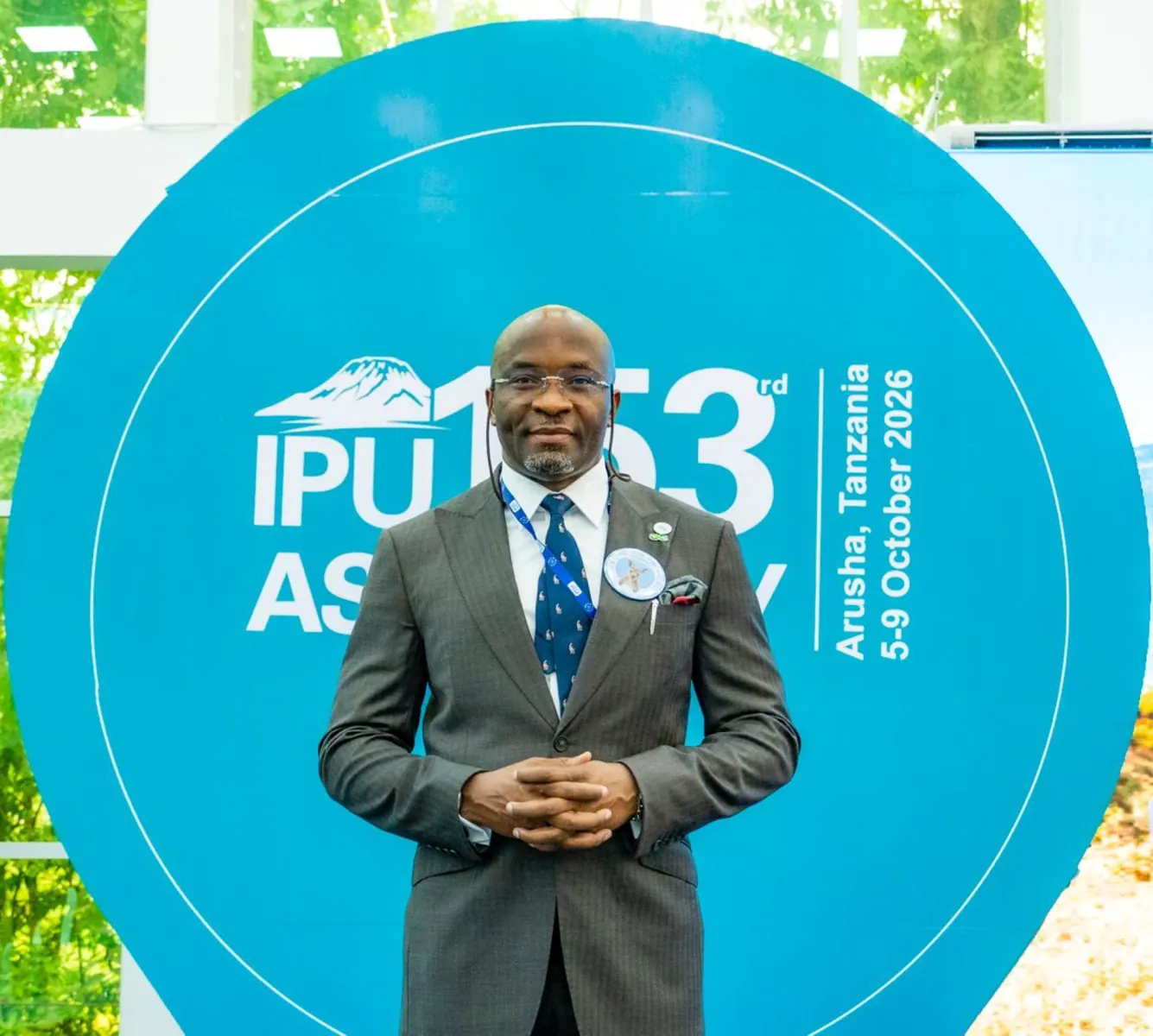
Nigeria's Deputy Speaker of the House of Representatives, Rt. Hon. Benjamin Kalu, has been increasingly involved in parliamentary diplomacy, reflecting a role that extends beyond traditional domestic lawmaking. Since becoming Deputy Speaker in June 2023, Kalu has occupied strategic platforms where Nigeria's legislative priorities intersect with regional integration, continental development, and global policymaking. His engagements across the ECOWAS Parliament, the Pan-African Parliament, and the Inter-Parliamentary Union (IPU) have placed him within significant forums for contemporary parliamentary diplomacy.
Kalu's growing international footprint is defined by the issues he has brought to these platforms. At the ongoing 153rd Assembly of the Inter-Parliamentary Union in Arusha, Tanzania, Kalu made a forceful case for urgent legislative action to confront climate-related disasters while positioning Nigeria as an emerging destination for climate-resilient investment. He framed the climate crisis not merely as an environmental question, but as a development, economic, and social imperative. He drew attention to the realities confronting communities across the world, from irregular rainfall and declining agricultural yields to coastal erosion, rising waters, flooding, and unreliable energy supply.
For Nigeria, Kalu argued that climate action must ultimately be measured by its impact on ordinary citizens. He emphasized that climate action should focus on whether farmers can continue to produce food despite changing weather patterns, whether households can access affordable and reliable electricity, whether young people can find dignified employment, and whether communities and cities can withstand the growing consequences of extreme weather. This framing marked an important shift from climate diplomacy as a conversation dominated by pledges to one centered on legislation, investment, and measurable outcomes.
Kalu told fellow parliamentarians that Nigeria was not attending the global forum simply to repeat the call for climate finance. Rather, the country was presenting an investment proposition built around a growing pipeline of commercially viable and climate-resilient projects, backed by public policy, legislation, and institutions. He pointed to Nigeria's commitment to achieving net-zero emissions by 2060 and the country's Energy Transition Plan as evidence of a development-centered approach to the green transition.
The Deputy Speaker highlighted the scale of the opportunity, noting that Nigeria's energy transition pathway requires hundreds of billions of dollars in additional capital investment. He presented this requirement as an investment horizon capable of generating new markets, modernizing infrastructure, creating green jobs, encouraging innovation, and strengthening long-term economic resilience. For Kalu, the responsibility of parliamentarians is not limited to debating the climate crisis; legislatures must create the legal certainty and institutional environment required to convert climate ambitions into investable projects and tangible development.
Kalu identified areas ranging from renewable energy, solar mini-grids, and battery storage to clean cooking, electricity transmission and distribution, climate-smart agriculture, irrigation, cold-chain logistics, and resilient rural infrastructure as areas where Nigeria can attract investment while addressing pressing development needs. His intervention also extended to electric mobility, mass transit, waste-to-value systems, methane reduction, circular-economy enterprises, and green manufacturing, alongside adaptation measures such as flood-control systems, resilient drainage, coastal protection, climate-resilient housing, and infrastructure.
Canadian Senator Mohamed-Iqbal Ravalia commended Kalu's advocacy for Africa and his ability to articulate issues affecting people across the continent. Ravalia described Kalu as "brilliant" and "strategic," while commending his advocacy for Africa and his ability to articulate issues affecting people across the continent. The endorsement underscores an emerging dimension of Kalu's parliamentary profile: his international role is increasingly being assessed not merely through the offices he occupies, but through the quality and substance of his interventions.
Key points
- Kalu's intervention at the IPU 153rd Assembly emphasized the need for urgent legislative action to address climate-related disasters and position Nigeria as a destination for climate-resilient investment.
- Kalu's advocacy for Africa and his ability to articulate issues affecting people across the continent have earned him recognition from Canadian Senator Mohamed-Iqbal Ravalia.
- Kalu's approach to parliamentary diplomacy connects Nigeria's domestic legislative agenda with broader conversations about Africa's development, economic integration, democracy, climate resilience, and global cooperation.