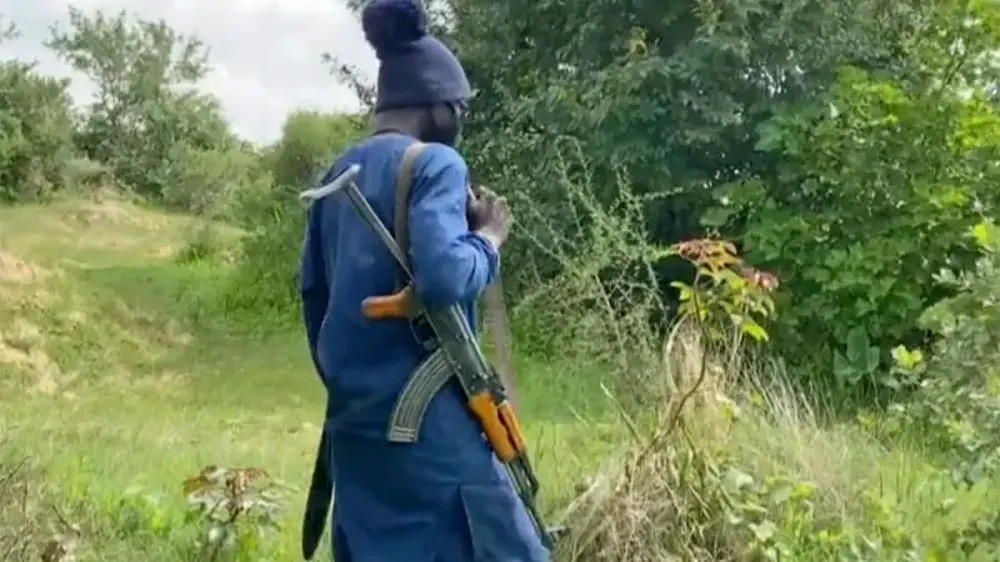
A video has been making rounds on social media, claiming to show Boko Haram militants taking new recruits in Nigeria. The footage, which has garnered over 136,500 interactions, depicts a group of individuals crawling through a seemingly closed-off war zone surrounded by trees. The video was posted by a user on August 18, 2026, and has sparked widespread concern and debate about the security situation in Nigeria.
Several social media users have expressed alarm and skepticism regarding the video, with some questioning its authenticity and others demanding action from the Nigerian military. While some users have accepted the video as evidence of Boko Haram's recruitment activities, others have raised doubts about its origin and connection to Nigeria. DUBAWA decided to investigate the claims to determine their veracity.
Upon examination, DUBAWA found that the environment depicted in the video resembles a Saharan desert, which is inconsistent with Nigeria's geography. Furthermore, the language used by the individuals in the video is not Hausa or Fulani, which are commonly spoken in northern Nigeria. Using Google Gemini translation software, DUBAWA discovered that the language used is a dialect of Arabic, commonly spoken in Sudan or Chad.
DUBAWA employed InVID software to extract key frames from the video and conducted a reverse image search using Google, TinEye, and Yandex. However, the search results did not yield any credible evidence linking the video to Boko Haram or Nigeria. The investigation suggests that the video may have originated from outside Nigeria.
Despite the video showing what appears to be military training, DUBAWA found insufficient evidence to support the claim that it depicts Boko Haram militants taking new recruits. The lack of concrete evidence and inconsistencies in the video have raised doubts about its authenticity and connection to Nigeria.
The proliferation of misinformation and disinformation on social media has become a significant concern, particularly in Nigeria, where security challenges persist. DUBAWA's investigation highlights the importance of verifying information before sharing or accepting it as true. The organization urges social media users to exercise caution and critically evaluate the information they consume.
The investigation was conducted under the Centre for Journalism, Innovation and Development (CJID) with support from the European Union (EU). DUBAWA's findings emphasize the need for fact-based reporting and verification in the face of escalating misinformation.
Key points
- The video circulating online does not provide sufficient evidence to support the claim that it depicts Boko Haram militants taking new recruits in Nigeria.