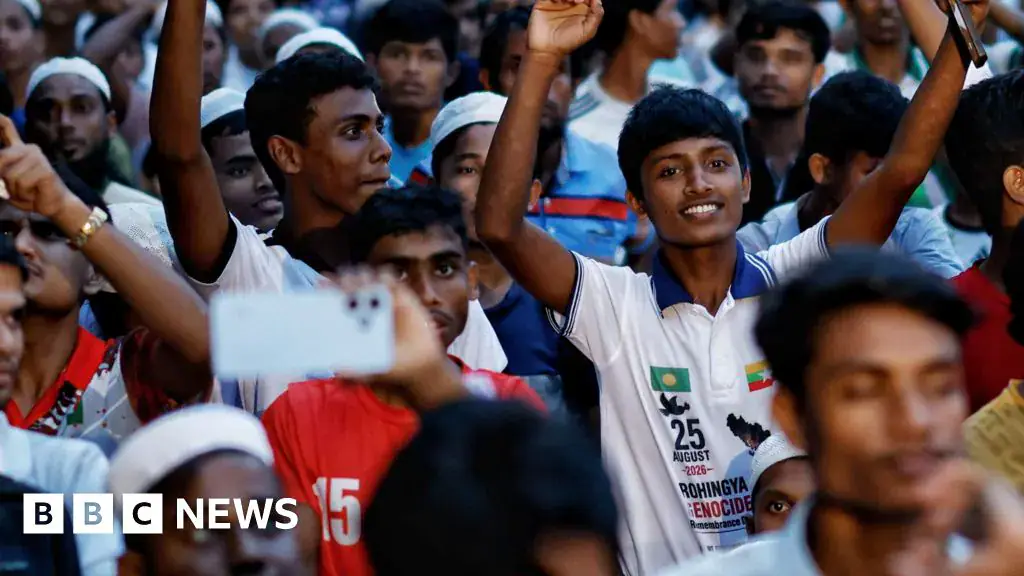
The International Court of Justice (ICJ) has delivered a landmark verdict, finding Myanmar guilty of committing genocide against the Rohingya minority. This historic judgment marks the first time a state has been found to have violated the 1948 Genocide Convention. The Rohingya people have been seeking justice for the atrocities committed against them in 2017, when at least 10,000 people were killed in attacks by Myanmar's security forces and local militias.
The ICJ's verdict was delivered after the Gambia brought the case to the court in 2019, with the backing of the Organisation of Islamic Cooperation. The court heard evidence of mass murder, rape, torture, and destruction of villages, with Rohingya residents burnt to death inside their homes. The judgment was passed with a majority of nine votes to six, reasserting and clarifying the standard of evidence needed to prove genocidal intent. This will have a significant impact on other genocide cases currently being heard by the court.
Proving intent is the biggest challenge in a genocide case at the ICJ, and the Gambia's success in proving Myanmar's intent to commit genocide will be studied by lawyers. The ICJ inferred evidence of genocidal intent from the actions taken by Myanmar's security forces and local militias against the Rohingya people. According to Janina Dill, Chair in Global Security at the Blavatnik School of Government of the University of Oxford, genocidal intent can be inferred from a pattern of conduct.
The ICJ's decision has implications for other genocide cases, including South Africa's case against Israel over the killing and destruction in Gaza. The court's approach in the Myanmar case clarifies the standard of evidence required to prove genocide, which will be applied in future cases. Philippe Sands KC, part of the Gambia's legal team, said that the verdict keeps the door open for South Africa's case against Israel.
The Rohingya people in Bangladesh have expressed joy and relief at the verdict, but it will not immediately improve their living conditions. The ICJ has told Myanmar to make reparations to the Rohingyas, but it has no mechanism to enforce its rulings. The UK has called for an urgent session of the UN Security Council and has promised other measures in the coming days.
The international community has reacted to the verdict, with the UK expelling Myanmar's defence attaché in London and promising further measures. The US has also commented on the case, with the Trump Administration weighing in. The verdict has been hailed as a significant step towards justice for the Rohingya people.
The ICJ's verdict is a reminder that international law still exists and can hold states accountable for their actions. The 1948 Genocide Convention was established to prevent a repeat of the brutality and genocide of World War Two, and the court's decision reinforces the importance of this convention. The verdict sends a clear message that such crimes cannot be committed with impunity.
Key points
- The ICJ's verdict is a historic judgment that marks the first time a state has been found to have violated the 1948 Genocide Convention.
- The verdict has implications for other genocide cases, including South Africa's case against Israel over the killing and destruction in Gaza.
- The ICJ's decision clarifies the standard of evidence required to prove genocide, which will be applied in future cases.