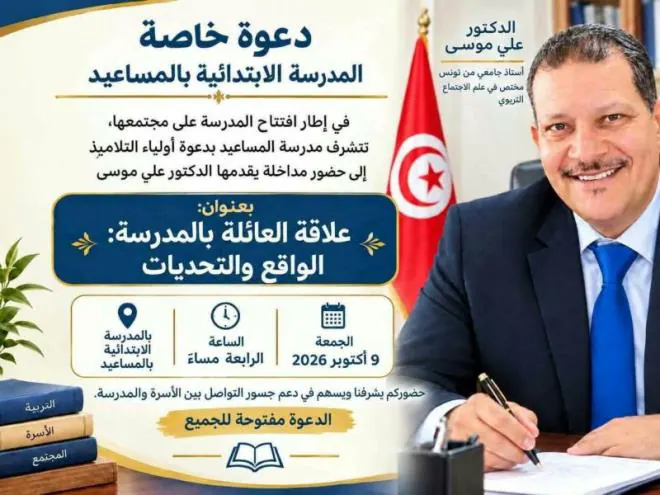
The Masayid Elementary School in southern Qibili, Tunisia, recently hosted an intellectual symposium that brought together educators and experts to discuss the relationship between families and schools. The event was part of efforts to achieve academic success and ensure the healthy development of children. The symposium featured a presentation by Dr. Ali Moussa, a professor at the University of Qafsa and a specialist in educational sociology.
Dr. Moussa emphasized that a child's development - biological, psychological, cognitive, emotional, and behavioral - requires joint guidance from both families and schools. He stressed that a balanced approach is necessary to ensure the proper upbringing of students, who serve as a link between their families and schools. Dr. Moussa noted that families and schools have their own customs, traditions, and regulations, which must be considered when working together.
According to Dr. Moussa, the child's safety and well-being depend on effective communication between families and schools. He argued that schools must be open to families to ensure the success of educational endeavors. This can be achieved by building a relationship that is free from conflicts and allows children to feel secure in both their family and school environments.
The symposium aimed to address various challenges facing families and schools, including difficulties in integrating children into the educational system and issues related to mobile phone addiction. Dr. Moussa announced plans to collaborate with the Regional Education Office to make the symposium an annual event with a regional scope, focusing on topics that promote cooperation between families and schools.
The event highlighted several key areas for improvement, including the importance of balancing family and school time, providing children with balanced nutrition, and maintaining their health. Dr. Moussa emphasized that parents must be involved in the educational process and take responsibility for their children's upbringing, particularly in the face of challenges posed by the modern era.
The symposium was part of a broader effort to address social issues affecting children, such as violence, harassment, and smoking. By promoting cooperation between families and schools, organizers hope to create a safer and more supportive environment for students. The event provided a platform for experts and educators to share their insights and develop strategies for improving the educational experience.
The intellectual symposium at Masayid Elementary School demonstrated the commitment of educators and policymakers in Tunisia to improving the country's education system. By engaging families and schools in the educational process, organizers aim to promote academic success, social integration, and the overall well-being of children.
Key points
- The symposium highlighted the importance of cooperation between families and schools in ensuring the healthy development and academic success of children.
- Dr. Ali Moussa emphasized the need for a balanced approach to guidance and support for children, taking into account the customs and regulations of both families and schools.
- The event was part of a broader effort to address social issues affecting children and promote a safer and more supportive educational environment.