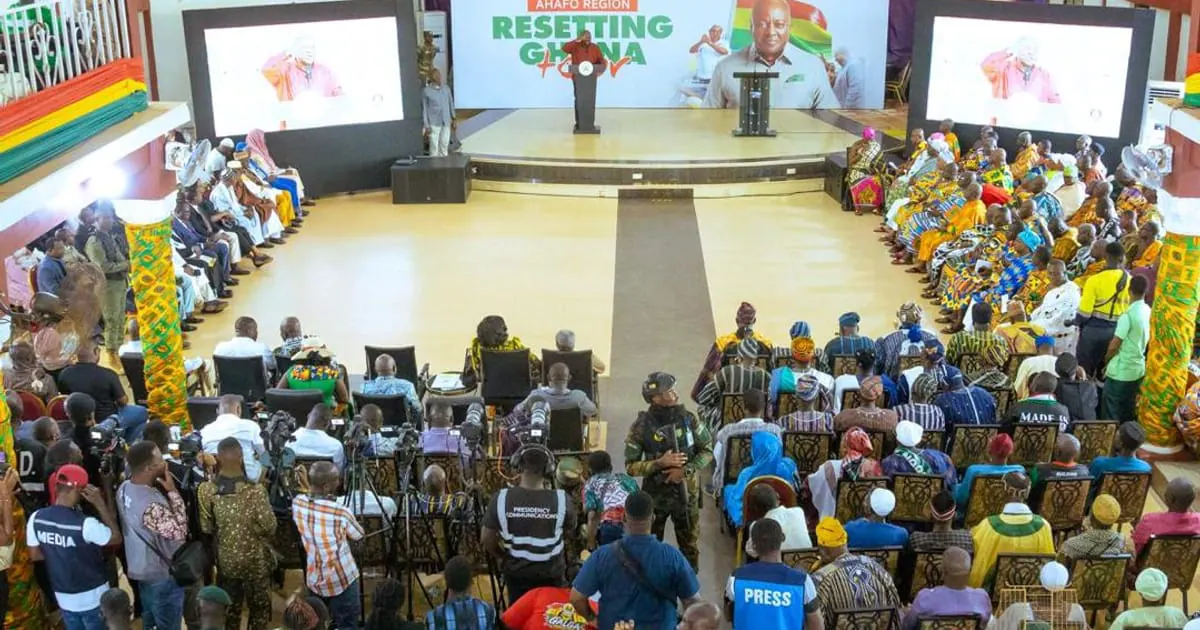
The United States has expressed interest in revising its proposed $109 million health compact with Ghana. President John Mahama disclosed this information during a citizens' engagement in Goaso, Ahafo Region. The US government has requested further discussions on the agreement, specifically regarding clauses that led to its rejection by Cabinet.
The proposed compact aimed to provide approximately $109 million in US health assistance over five years, replacing some funding previously received through the United States Agency for International Development (USAID). However, Ghana rejected the compact due to concerns about provisions relating to sensitive health information, national sovereignty, counterpart funding, and the regulatory authority of the Food and Drugs Authority (FDA).
President Mahama explained that Ghana followed established procedures in reviewing the document. The Ministry of Health reviewed the compact and submitted an information paper to Cabinet, which identified provisions considered problematic. One major concern was a requirement for Ghana to provide the US with its pathogen profile, containing information about disease-causing organisms circulating in the country.
The agreement also required Ghana to commit its own funds to the programme while restricting the FDA's authority to inspect medicines and other medical products brought into the country under the arrangement. President Mahama described these conditions as "humiliating." Cabinet ultimately rejected the agreement, and the government decided not to proceed with it under the proposed terms.
The US government's request for further discussions indicates a willingness to address Ghana's concerns. President Mahama stated that the two parties will sit down to discuss the objectionable clauses, with a view to either amending or removing them. This development suggests a potential breakthrough in the negotiations.
The health compact was intended to support Ghana's healthcare sector, but the rejected provisions raised concerns about national sovereignty and data ownership. The country's decision to engage in further discussions with the US government demonstrates its commitment to finding a mutually beneficial solution.
The outcome of these discussions will determine the future of the health compact and the level of US assistance Ghana receives. President Mahama's disclosure has sparked interest in the negotiations, with many stakeholders eager to see the agreement revised to address Ghana's concerns.
Key points
- The US wants to revise its proposed $109 million health compact with Ghana.
- Ghana rejected the compact due to concerns about provisions relating to sensitive health information and national sovereignty.
- The US government has requested further discussions to address Ghana's concerns.