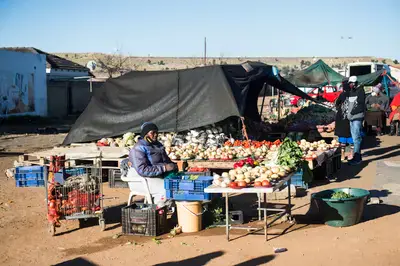
Informal traders play a vital role in feeding Africa's cities, yet they have little say in how food is governed. These traders, including women selling produce at taxi ranks and spaza shop owners providing credit to families, supply most of the food consumed by poor urban households. Despite their significant contribution, they are often excluded from decision-making processes around food policy. This exclusion is not an oversight, but rather a deliberate design of food governance that prioritizes the interests of corporations and funders.
The governance of Africa's food systems is characterized by the dominance of micro, small, and medium enterprises, most of which are informal. In fact, around 85% of Africa's food system runs through these informal enterprises. Moreover, more than four in five African workers are informally employed, with women being disproportionately represented in this sector. As Africa's urban population is expected to double by 2050, informal traders will continue to be a primary source of food for most urban dwellers.
The current food governance structure is influenced by outdated ideas, such as the notion that development policy should prioritize rural areas over cities. Economist Michael Lipton's 1970s argument that development policy favored cities over the countryside still shapes funding decisions, with large funders like the Gates Foundation and the Food and Agriculture Organisation of the United Nations focusing on increasing food production on farms. However, this approach neglects the reality of urbanization in Africa, where most urban growth now comes from people born in cities.
Another assumption driving food policy is that if enough food exists, people can access it. However, this assumption ignores the issue of affordability. The Western Cape's results in the National Food and Nutrition Security Survey illustrate this point, as the survey found that roughly the same share of households went hungry on farms as in towns and cities. Nevertheless, the report's recommendations focused on rural areas, neglecting the fact that 95% of the province's population lives in urban areas, resulting in a significant gap in addressing urban hunger.
The rules for participating in food governance also create barriers for informal traders. Donor programs require formal logframes and audited accounts, while consultations are often held in inaccessible locations and languages, excluding traders who would lose a day's sales by attending. In South Africa, the provincial hearings on the new National Food and Nutrition Security Plan risk perpetuating this exclusion, as they are organized by premiers' offices with discretionary invitations.
Facilitator organizations have emerged to bridge the gap, promising to convene stakeholders and amplify the voices of the marginalized. However, these organizations are often dependent on donor funding and tied to measurable results, which can compromise their ability to represent the interests of informal traders. At the global level, a study found that executives from the ultra-processed food industry hold a significant proportion of board seats in multistakeholder initiatives, further entrenching corporate power.
To address the deepening hunger crisis in Africa, it is essential to recognize the role of informal traders in feeding poor households and involve them in food governance. This requires a shift in how accountability is understood and practiced, with a focus on giving accountability teeth through social audits, community scorecards, and public reporting in local languages. South Africa's draft plan proposes local food system forums, which could provide a platform for informal traders to participate in decision-making processes.
Key points
- Informal traders are excluded from food governance despite supplying most of the food consumed by poor urban households.
- Outdated ideas and assumptions, such as prioritizing rural areas and assuming that food availability guarantees access, drive food policy and neglect the realities of urbanization.
- A shift in accountability and representation is necessary to involve informal traders in food governance and address the deepening hunger crisis in Africa.