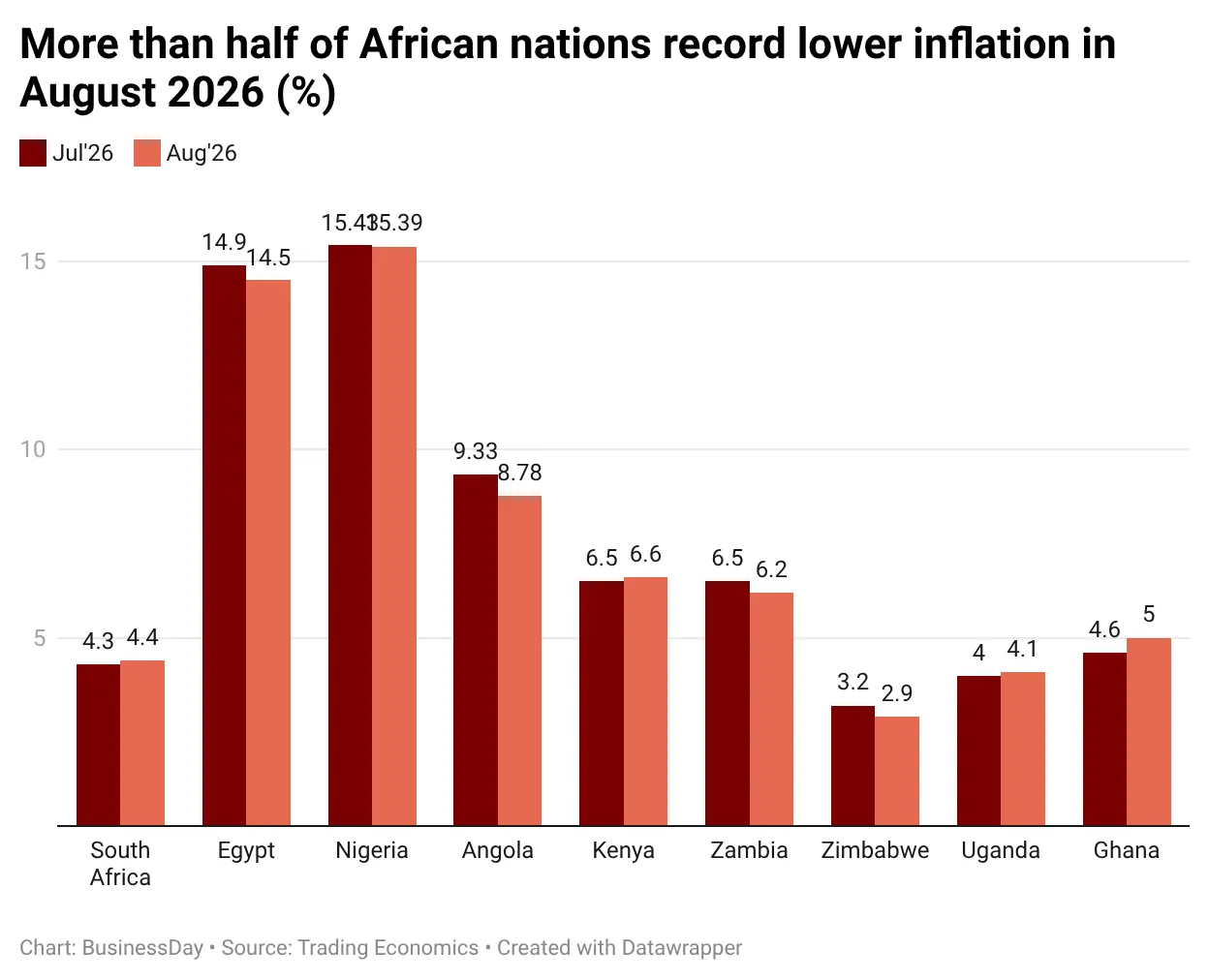
In August, a majority of African economies experienced a decline in inflation, continuing the continent's disinflation trend. Nine out of 16 economies tracked recorded lower annual inflation rates compared to July. Mozambique, Côte d'Ivoire, and Angola were among those with the largest declines. However, this improvement occurred before global oil prices surged above $100 per barrel in September, potentially complicating the disinflation trend.
Mozambique recorded the sharpest decline in inflation, with the annual rate falling to 6.45 percent in August from 7.48 percent in July. This decrease was largely driven by lower food and non-alcoholic beverages inflation, which dropped to 8.91 percent from 12.62 percent. Other categories, such as clothing and footwear, restaurants and hotels, and miscellaneous goods and services, also experienced moderated price growth.
Côte d'Ivoire and Angola also saw significant declines in inflation. Côte d'Ivoire's inflation rate fell to 1.2 percent from 1.9 percent, the lowest among the tracked economies. Angola's inflation rate dropped to 8.78 percent from 9.33 percent, its lowest level since April 2015. The decline in Angola has been supported by stability in the kwanza and improved domestic supplies of essential goods.
Despite these declines, some African economies continue to face high inflation rates. Nigeria, Egypt, and Ethiopia still struggle with elevated inflation rates. Nigeria's inflation rate eased marginally to 15.39 percent from 15.43 percent, while Egypt's inflation rate fell to 14.5 percent from 14.9 percent. Ethiopia's inflation rate decreased to 15.1 percent from 15.3 percent. These countries remain among the continent's highest-inflation economies.
The impact of rising global oil prices is a significant concern for many African economies. Higher fuel costs can quickly translate into increased transportation and logistics expenses, affecting the cost of moving food and other goods. In Nigeria, petrol prices have risen to about N1,400 per litre in Lagos and Abuja, while diesel prices have exceeded N2,000 per litre.
In Southern Africa, the inflation trends were mixed. Zambia, Zimbabwe, and Botswana recorded declines in inflation, while South Africa saw a modest increase. Botswana's inflation rate fell to 9.3 percent from 9.4 percent, driven by lower inflation in transportation, food, and non-alcoholic beverages. Zimbabwe's inflation rate decreased to 2.9 percent from 3.2 percent, and Zambia's inflation rate dropped to 6.2 percent from 6.5 percent.
East Africa and other regions experienced a different trend, with some economies seeing increased inflation rates. Kenya's inflation rate rose to 6.6 percent from 6.5 percent, driven by transportation costs. Ghana and Mauritius also recorded increases in inflation, with Ghana's rate rising to 5 percent from 4.6 percent and Mauritius' rate increasing to 4.9 percent from 4.4 percent.
Key points
- Nine out of 16 African economies tracked recorded lower annual inflation rates in August.
- Rising global oil prices above $100 per barrel threaten to reverse some of the gains made in disinflation trends.
- Countries such as Nigeria, Egypt, and Ethiopia continue to face high inflation rates despite overall declines in inflation across the continent.