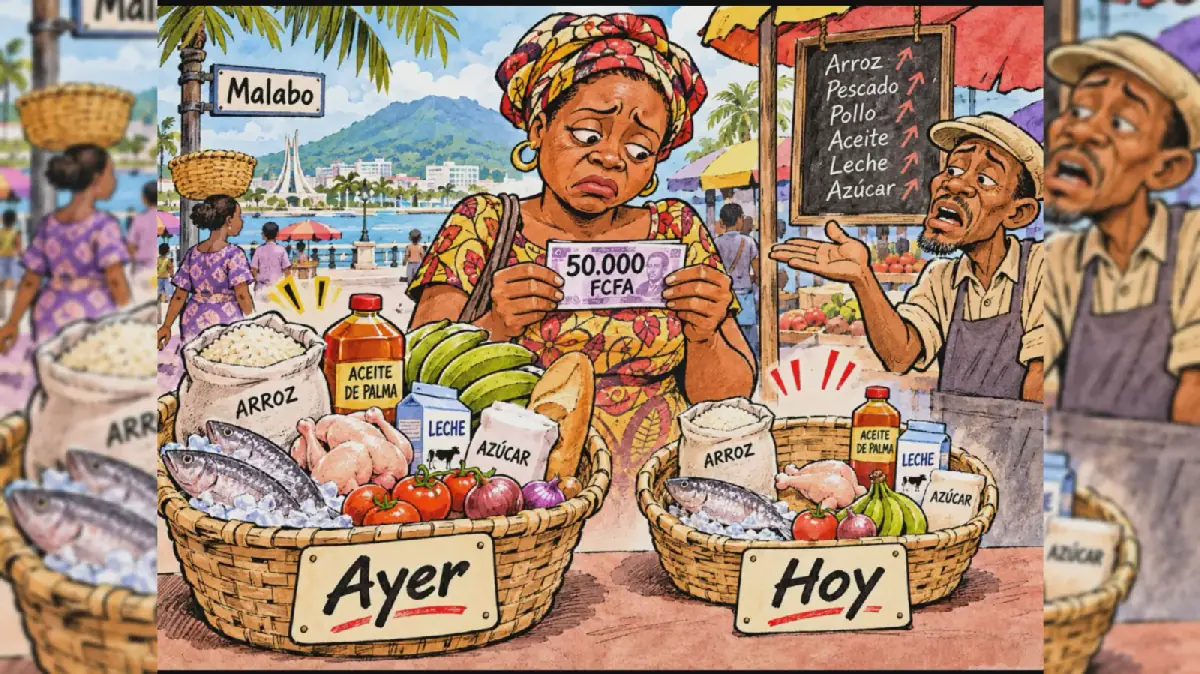
The National Institute of Statistics of Equatorial Guinea (INEGE) recently reported an annual inflation rate of 3.5%, but the increase in the general price index between October 2025 and October 2026 was 6.5%. To understand the impact of this inflation, consider a mother who buys essential goods such as rice, fish, chicken, cassava, bananas, palm oil, bread, tomatoes, onions, milk, and sugar with 50,000 CFA francs. If prices increased by 6.5%, she would now need 53,250 CFA francs to buy the same items, leaving her with 3,250 CFA francs less.
The products in the mother's shopping list are common household items in Equatorial Guinea, as recorded in the INEGE's National Household Survey. The exercise illustrates how inflation affects the purchasing power of citizens. The mother does not need to understand the statistical differences in inflation measurement; she knows that with the same amount of money, she can no longer buy what she had planned, and she must reduce quantities, substitute products, or increase her budget.
The INEGE report highlights that the inflation rate for imported products is 4.8%, compared to 2.0% for local products. This suggests that imported goods, such as rice, chicken, and milk, are under greater pressure due to international costs, transportation, and import conditions. However, once these products enter Equatorial Guinea, additional costs and margins are added during storage, transportation, and distribution, affecting the final price.
Another interesting finding is the disparity in inflation rates between Malabo and Bata. Malabo has an annual inflation rate of 5.2%, while Bata has a rate of 1.8%. This significant difference raises questions about the factors contributing to these variations. The response may be related to supply and costs, as the two cities have different economic conditions.
The impact of inflation on citizens' daily lives is significant. With the same amount of money, people can no longer afford the same goods and services. This forces them to make difficult choices, such as reducing consumption, substituting products, or increasing their budget. The INEGE's report provides valuable insights into the inflation rate, but it is essential to understand the underlying factors driving these changes.
To mitigate the effects of inflation, it is crucial to understand its causes. The INEGE's report suggests that imported products are under greater pressure, but it is also essential to examine the role of local factors, such as storage, transportation, and distribution costs. By understanding these factors, policymakers can develop targeted strategies to address inflation and support citizens.
The situation in Equatorial Guinea highlights the importance of monitoring inflation and its impact on citizens' daily lives. As the country continues to navigate economic challenges, it is essential to develop effective policies to address inflation and support economic growth. The INEGE's report provides a valuable starting point for this discussion, and further analysis is needed to understand the complex factors driving inflation in Equatorial Guinea.
Key points
- The inflation rate in Equatorial Guinea has risen, affecting the purchasing power of citizens.
- Imported products are under greater pressure, with an inflation rate of 4.8%.
- There is a significant disparity in inflation rates between Malabo and Bata, with rates of 5.2% and 1.8%, respectively.
Reporting sources
- La inflación en Guinea Ecuatorial: ¿qué cabe hoy en una cesta de 50.000 francos CFA? · AHORAEG Guinea Ecuatorial - Diario online líder de noticias