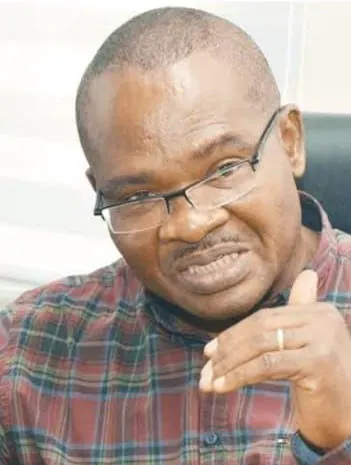
Clement Nwankwo, Executive Director of Policy and Legal Advocacy Centre (PLAC), has expressed concerns about the bloated voters' register, which currently stands at over 103 million. He made these remarks in an interview, where he also emphasized the need for INEC to be transparent in the management of funds. According to Nwankwo, INEC's preparedness for the upcoming elections is crucial, and the commission must ensure that the electoral process is free and fair.
Nwankwo reacted to the recent press conference held by INEC Chairman, Professor Joash Amupitan, where he provided updates on the registration of voters and the commission's preparations for the elections. Amupitan stated that the northwest part of the country dominates the voters' register and set October 9 as the date for people to start collecting their permanent voter cards. Nwankwo noted that while it is essential for INEC to brief stakeholders ahead of the elections, the commission must also address concerns about the voters' register, which he described as bloated.
The Electoral Act is clear on campaign financing, stating that it should be calculated from the date the notice of election is issued. However, Nwankwo noted that INEC has not issued guidelines on campaign spend limits for parties and candidates. The Act stipulates limits for election campaign expenses, such as N10 billion for presidential candidates, N500 million for governors, and N250 million for National Assembly members. Nevertheless, INEC has not provided information on how it plans to monitor campaign spending or address issues related to monies received by political parties from anonymous sources.
Nwankwo emphasized that the lack of transparency in campaign financing can lead to abuse and underdevelopment in the country. He noted that monies meant for development are often diverted for election campaigns, resulting in excessive expenditures by political parties and candidates. According to Nwankwo, INEC must have mechanisms in place to monitor spending and ensure that candidates and parties comply with the Electoral Act.
The Electoral Act of 2026 stipulates that candidates who exceed the spending limits will face consequences, including fines. Nwankwo stated that if a candidate exceeds the limit, they are supposed to pay a fine, which is five times the cost of the excess. However, there is no evidence that INEC has taken steps to enforce these provisions. Nwankwo also mentioned that the National Assembly has had debates on setting up an electoral offenses commission, which is still pending.
Nwankwo stressed the importance of INEC being non-partisan and unbiased in applying the law. He noted that the commission's response to court interpretations of the Electoral Act and the Constitution is crucial in ensuring that the electoral process is free and fair. According to Nwankwo, INEC must ensure that the procurement of materials for elections is transparent, and the commission should provide information on vendors and suppliers.
The interview highlighted the need for INEC to be proactive in addressing concerns about the electoral process. Nwankwo emphasized that the commission must take steps to ensure that the upcoming elections are free, fair, and transparent. The issue of campaign financing and monitoring of spending by INEC remains a critical aspect of the electoral process, and Nwankwo's call for transparency and accountability is timely.
Key points
- Clement Nwankwo calls for INEC to monitor campaign spending by political parties and candidates.
- The voters' register currently stands at over 103 million, with concerns about its bloated nature.
- INEC must ensure transparency in the management of funds and procurement of materials for elections.