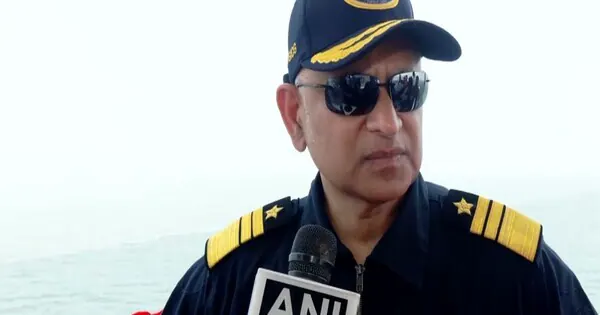
The Indian Coast Guard (ICG) recently hosted the 12th National Maritime Search and Rescue Exercise, SAREX-2026, off the coast of Paradip, Odisha. Director General of the ICG, S Paramesh Sivamani, emphasized the importance of the exercise in strengthening interoperability and inter-agency coordination to minimize response and reaction times in the event of a maritime incident. A total of 32 vessels participated in the exercise, including ships from the Indian Coast Guard, Navy, and Customs/Port authorities, as well as aircraft from the Indian Air Force.
The exercise, conducted under the theme "Leveraging Technology to Strengthen SAR Preparedness and Maritime Safety," brought together maritime and aeronautical agencies to demonstrate operational readiness, interoperability, and coordinated response to mass rescue operations at sea. The scenario simulated a Mass Rescue Operation following a concurrent aeronautical and maritime distress emergency, involving a passenger aircraft carrying 228 persons that ditched at sea near Paradip Port. The exercise involved activation of the Incident Command Post, firefighting operations, helicopter evacuations, and deployment of life rafts and air-droppable life rafts.
The exercise also included a demonstration of Remotely Operated Vehicle (ROV) capability and involved 32 observers from 30 countries. The observers participated in a "tabletop exercise" where they were explained the scenario currently playing out at sea and actively involved in the search planning process. This allowed them to understand the mechanics of executing a search and rescue operation. The SAREX-2026 exercise reaffirmed the collective resolve of India and its international partners to build a faster, technology-enabled, and seamlessly coordinated Search and Rescue framework.
Australia and Tanzania lauded India's vessel manufacturing capabilities, with Blaise Taylor, Counsellor at the Australian Border Force (ABF), hailing the MoU between Australia and the Indian Coast Guard. Taylor described the level of capability of the Indian Coast Guard as "seriously impressive" and noted that India's sovereign technology is very impressive, with 70% of the vessel they were on being manufactured in India. Lt. Colonel Alann Bashaula from Tanzania described the exercise as an educational experience and lauded the fact that most of the Indian ships in the exercise were manufactured by the host nation.
The assets deployed during the exercise included 15 Coast Guard ships, three Dornier aircraft, three Advanced Light Helicopters, one Chetak helicopter, IAF C-130J and Mi-17 aircraft, two Indian Navy ships, along with civil and state resources and shore-based support units. The exercise simulated a complex scenario involving a passenger aircraft ditching at sea, with the fuselage impacting a container vessel, resulting in structural damage and fire. The response to the scenario involved a coordinated effort from multiple agencies, demonstrating the effectiveness of the Indian Coast Guard's search and rescue capabilities.
The SAREX-2026 exercise was conducted under the aegis of the National Maritime Search and Rescue Board (NMSARB) and aligns with the vision of SAGAR and the spirit of Mahasagar. The exercise demonstrated India's capabilities in search and rescue operations and its commitment to maritime safety. The Indian Coast Guard's efforts to strengthen interoperability and inter-agency coordination were highlighted during the exercise, which will help minimize response and reaction times in the event of a maritime incident.
The success of the SAREX-2026 exercise highlights the importance of international cooperation and coordination in search and rescue operations. The exercise provided a platform for India to engage with international partners and demonstrate its capabilities in maritime search and rescue. The Indian Coast Guard's role in promoting maritime safety and security was emphasized during the exercise, which will contribute to a safer and more secure maritime environment.
Key points
- The exercise involved 32 vessels and observers from 30 countries, demonstrating India's commitment to international cooperation in search and rescue operations.
- Australia and Tanzania lauded India's vessel manufacturing capabilities, highlighting India's sovereign technology and self-reliance.
- The exercise simulated a complex scenario involving a passenger aircraft ditching at sea, demonstrating the effectiveness of the Indian Coast Guard's search and rescue capabilities.