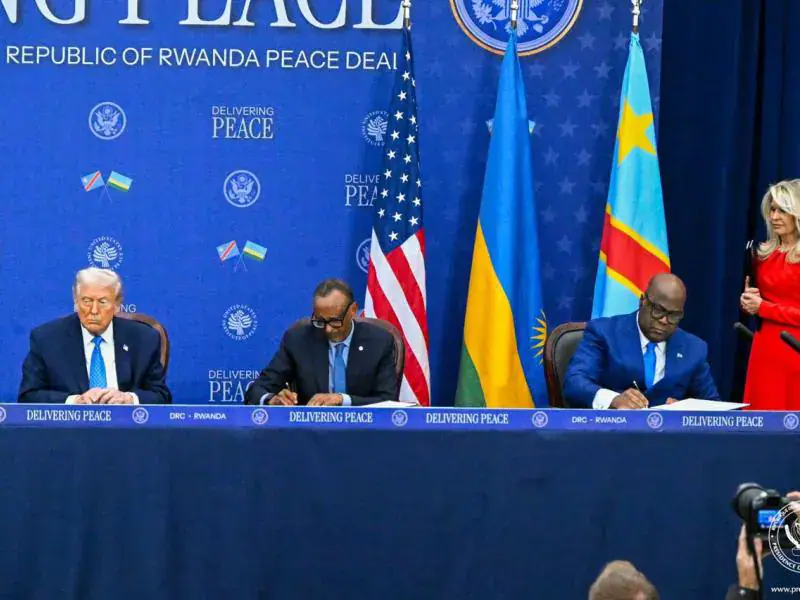
The Washington Peace Agreement, signed on June 27, 2025, under the auspices of the United States, aims to bring peace between the Democratic Republic of Congo (DRC) and Rwanda. According to a report by the Barometer of African Peace Agreements (BAPA), the overall implementation rate of the agreement stood at 33.3% as of October 2026, down from 35% in July 2026. This represents a decline of 1.7 percentage points.
The decline in implementation rate affects both countries' individual commitments. The DRC's implementation rate decreased from 31.7% to 30.8%, while Rwanda's rate dropped from 30.6% to 29.5%. The BAPA report attributes this regression to several factors, including ongoing hostilities in eastern DRC, persistent disagreements on the neutralization of the Democratic Forces for the Liberation of Rwanda (FDLR), and the disengagement of forces and lifting of defensive measures by Rwanda.
The report highlights that the limited verification capacities, deteriorating political and security relations, and humanitarian access difficulties are among the obstacles. The BAPA report also mentions that the implementation of the Operations Order (OPORD), developed in September 2025, has been incomplete. The OPORD aimed to translate the Concept of Operations (CONOPS) into coordinated operational actions on the ground.
The DRC and Rwanda reviewed progress in November 2025, including intelligence sharing on FDLR locations and a DRC-led disarmament campaign. However, the implementation of Phase 2, focusing on planning operations to neutralize FDLR and lift Rwandan defensive measures, has been hindered by disagreements on sequencing, verification mechanisms, and the security situation.
The sixth meeting of the Joint Security Coordination Mechanism (JSCM) in August 2026 considered revising the operational planning process to address persistent obstacles. Although a JSCM conference on OPORD made progress in finalizing the revised project, no new version had been officially approved by October 31, 2026.
The lack of an updated and operationally viable plan continues to hinder the implementation of security commitments. The BAPA evaluation framework led to a downward revision of scores for two tasks related to implementing the harmonized plan for FDLR neutralization and the plan for force disengagement and lifting of Rwandan defensive measures.
Despite the signing of the Washington Peace Agreement and the Doha process, the situation on the ground remains unchanged. Hostilities persist between Kinshasa's forces and the AFC/M23 rebellion, backed by Rwanda and now known as the Front for Refoundation of the Nation (FRN), led by Joseph Kabila.
Key points
- The implementation rate of the Washington Peace Agreement has dropped to 33.3% as of October 2026.
- Ongoing hostilities in eastern DRC and disagreements on FDLR neutralization have contributed to the decline in implementation rate.
- The lack of an updated and operationally viable plan hinders the implementation of security commitments.