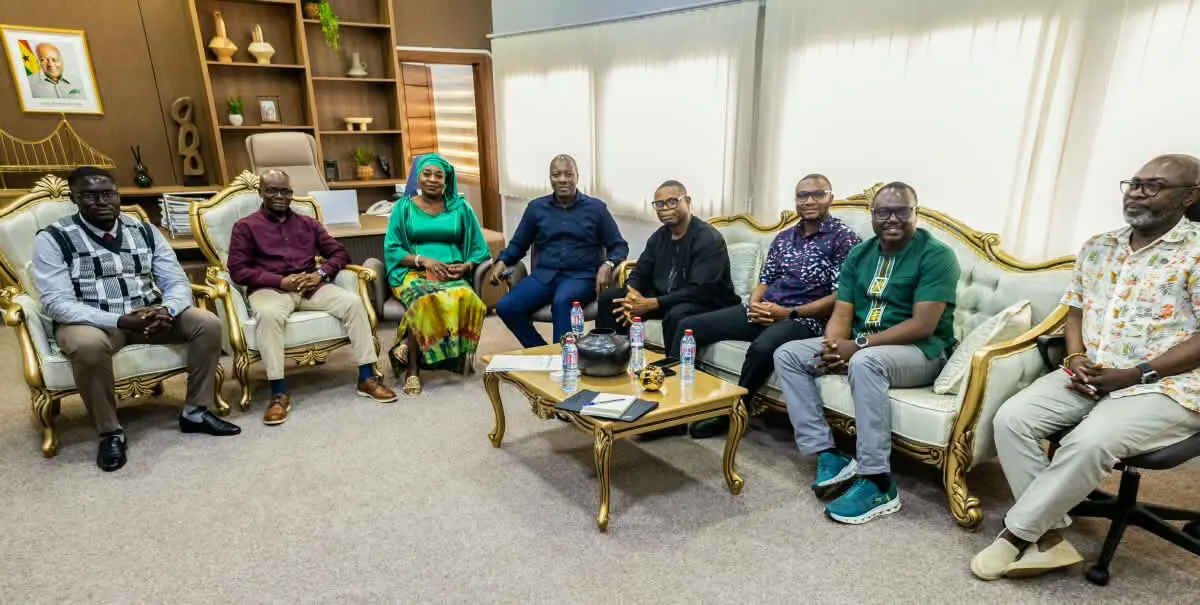
Policy think tank IMANI Africa and the Ministry of Local Government, Chieftaincy and Religious Affairs recently engaged in discussions on proposed interventions aimed at improving urban management, strengthening local government institutions, and increasing internally generated funds for municipal development. The meeting, which took place on September 18, 2026, involved the Minister, Chief Director, the Chairperson of Parliament’s Committee on Local Government, and representatives of IMANI Africa.
The discussions focused on reorganising waste collection in the Greater Accra Region into three operational blocks, with dedicated disposal infrastructure intended to reduce the distance waste collection trucks travel. A two-bin system was proposed, with households expected to separate organic and non-organic waste at source. Digital monitoring of compliance, including possible automated penalties for households that mix waste, was also discussed.
A centralised digital platform for property-rate collection was proposed to reduce reliance on manual collection and limit opportunities for leakages and middlemen. The proposed system would link property and spatial data from several public institutions, including the Electoral Commission, Ghana Statistical Service, Ghana Post, and security-related agencies. This aims to strengthen the link between local taxation and visible community development.
Urban mobility was another major focus, with discussions around the use of contraflow arrangements on selected major corridors during peak periods. The proposal involves temporarily using an opposing lane to give high-capacity public buses a dedicated route through congested areas. Routes identified for consideration include Madina, Amasaman, Kasoa, Tema, and Legon.
The redevelopment of the Agbogbloshie enclave was also discussed, including the dredging of the lagoon and removal of accumulated waste. The proposal involves clearing the area over an extended period and relocating unauthorised settlements as part of efforts to restore the environment. Plans were discussed for developing industrial and housing zones on recovered land.
Measures to give Metropolitan, Municipal and District Assemblies a stronger economic development role were explored. One proposal is the appointment of regional economists to support district planning officers and help assemblies track indicators such as economic growth, job creation, and infrastructure development.
The stalled Kejetia Market Phase II project also featured in the discussions, with a focus on mobilising financing for the project. The engagement considered various proposals aimed at improving urban management and local government institutions, reflecting a collaborative approach between IMANI Africa and the Ministry of Local Government.
Key points
- Discussions between IMANI Africa and the Ministry of Local Government focused on sanitation reform, local revenue mobilisation, and urban infrastructure development.
- Proposed reforms include digital property-rate collection and reorganised waste collection systems.
- The engagement also explored measures to strengthen local government capacity and redevelop key areas such as Agbogbloshie.