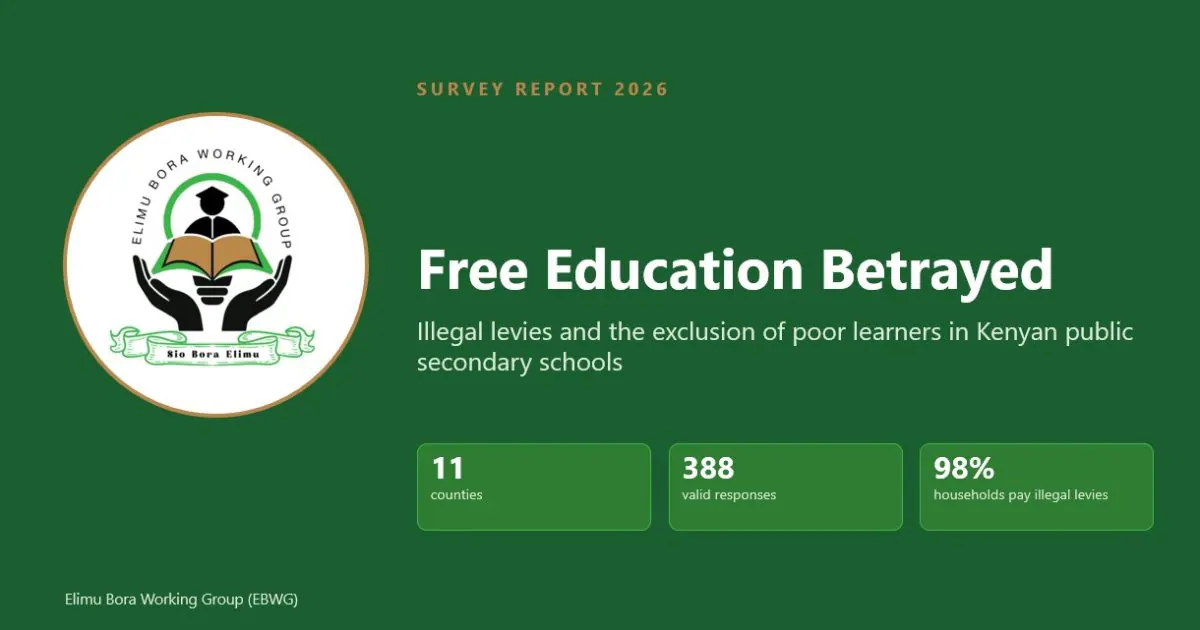
A recent survey by the Elimu Bora Working Group has revealed that 98 per cent of households in Kenya have paid or are expected to pay illegal charges in public secondary schools. The 2026 Illegal School Levies Survey found that additional charges, including development, activity, ICT, Parent-Teacher Association, remedial tuition, and motivation fees, are widespread across schools. These levies are forcing families to shoulder costs beyond official fees.
The survey analysed 388 valid responses from 12 counties and found that parents accounted for 78 per cent of respondents, with 61 per cent of households reporting monthly incomes below Sh30,000. The report noted that most respondents are parents with low household incomes. The survey also found that 49.2 per cent of households are expected to pay remedial or motivation fees in 2026, up from 37.4 per cent in 2025.
The report attributed part of the increase in levies to the transition of the first Competency-Based Curriculum cohort to Grade 10, with ICT-related charges increasing sharply. The survey found that households paying an ICT levy jumped from 2 per cent to 43 per cent. The report also noted that boarding school costs were significantly higher than the gazetted fee ceiling, with the average boarding school bill standing at Sh62,715.
The survey found that day-school families pay around Sh20,000 for a service that should be free, while boarding families pay well above the official cap. The report also noted that the cost of uniforms and bedding is another major burden, with the typical admission kit estimated at Sh22,050, equivalent to 41 per cent of the annual school fee. Some parents reported paying as much as Sh54,857 for a single boarding uniform set.
The financial pressure is reflected in how families view the charges, with 61.6 per cent of respondents considering the levies difficult or unaffordable. The survey also found limited transparency in the use of levy funds, with 58.2 per cent of respondents saying they had received no meaningful explanation of how the money collected was used. Most parents appeared reluctant to complain, with 87.4 per cent having never lodged a complaint.
The consequences for learners are significant, with 64.9 per cent of day-school respondents and 40.5 per cent of boarding-school respondents saying learners had been sent home or excluded from school activities because of unpaid levies. Examination access was also affected, with 51.1 per cent of day-school respondents saying learners had missed examinations because of unpaid charges.
The report recommended a national audit of school fee structures, sanctions against institutions imposing unauthorised charges, and refunds to parents who had paid illegal levies. It also called for transparent procurement practices, timely release of full capitation funds to schools, and an end to single-vendor arrangements for uniforms and bedding.
Key points
- Unauthorised levies are widespread in Kenyan public secondary schools.
- The levies are forcing families to shoulder costs beyond official fees.
- The survey recommended a national audit of school fee structures and sanctions against institutions imposing unauthorised charges.