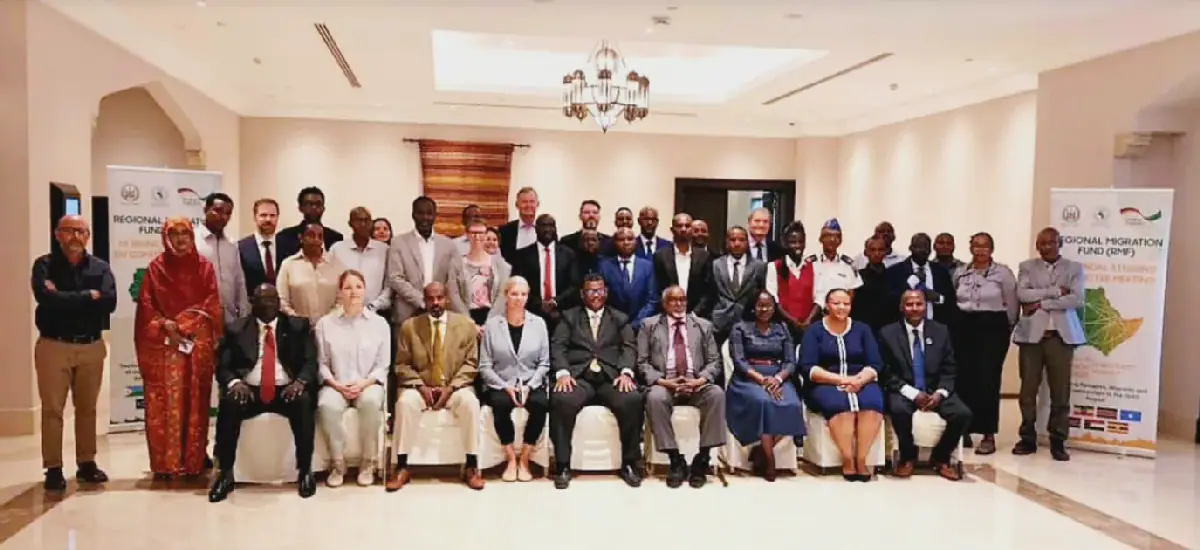
The Intergovernmental Authority on Development (IGAD) recently convened its 6th annual meeting of the Steering Committee for the Regional Migration Fund (RMF) in Djibouti. The two-day meeting, which took place on November 10-11, 2026, brought together representatives from member states, development partners, and stakeholders involved in implementing the fund. Djibouti's Ambassador to international organizations, Guelleh Idris Omar, addressed the opening ceremony on behalf of the Republic of Djibouti, which currently holds the IGAD presidency.
Ambassador Guelleh emphasized the strategic importance of the RMF in addressing collective migration challenges in the Horn of Africa region. He commended IGAD's commitment and partnership with the German government, specifically the Federal Ministry for Economic Cooperation and Development (BMZ) and the German Development Bank (KfW). The ambassador highlighted the fund's role in improving socio-economic conditions for migrants, refugees, and host communities through infrastructure development, livelihood enhancement, and resilience building.
The meeting evaluated progress made since the fund's inception in 2019, including notable investments in Ali-Sabieh and Ali-Addeh. Ambassador Guelleh called for ensuring the sustainability of these investments, strengthening national and local ownership, and enhancing intervention effectiveness. He urged participants to review progress, operational constraints, financial reports, and audit findings to formulate concrete recommendations for the fund's next phase.
Speaking on behalf of IGAD's Executive Secretary, Dr. Workneh Gebeyehu, Deputy Executive Secretary Muhammed Abdi Ware expressed gratitude to the Djiboutian government for its hospitality and commitment to regional cooperation and development. He highlighted tangible results achieved in Djibouti through approximately €10 million in investments, which have strengthened educational infrastructure, economic opportunities, community services, and social cohesion.
Key achievements in Djibouti include the establishment of community markets in Ali-Sabieh and Ali-Addeh, benefiting 117 households or around 850 people. Additionally, the extension and modernization of Ali-Sabieh's Technical High School have improved the learning environment for 400 students, with an additional 200 accommodation places. The Ali-Addeh Community Development Center offers spaces for interaction, learning, and skills development to over 6,000 people, mostly refugees.
At the regional level, IGAD reported encouraging progress in cross-border areas such as Moyale (Ethiopia-Kenya) and Tog-Wajale (Ethiopia-Somalia). Several priority projects have advanced towards the construction phase, while others are undergoing design and feasibility studies. Preparations are also underway along the Nimule-Elegu corridor (South Sudan-Uganda), where community priorities have been identified.
Despite implementation challenges, including rising construction costs and supply chain disruptions, Deputy Executive Secretary Ware emphasized the need for adaptive approaches, strong partnerships, and close coordination with member states. He reaffirmed IGAD's readiness to engage in technical negotiations and finalize the financing agreement for additional resources announced for the fund.
Key points
- The IGAD meeting in Djibouti focused on evaluating progress and strategic directions for the Regional Migration Fund.
- The fund has achieved tangible results in Djibouti, including investments in educational infrastructure, economic opportunities, and community services.
- IGAD reported encouraging progress in cross-border areas, with several priority projects advancing towards the construction phase.
Reporting sources
- L’IGAD réaffirme son engagement en faveur du renforcement du Fonds régional pour la migration lors de sa 6e réunion annuelle à Djibouti · agence djiboutienne d'information