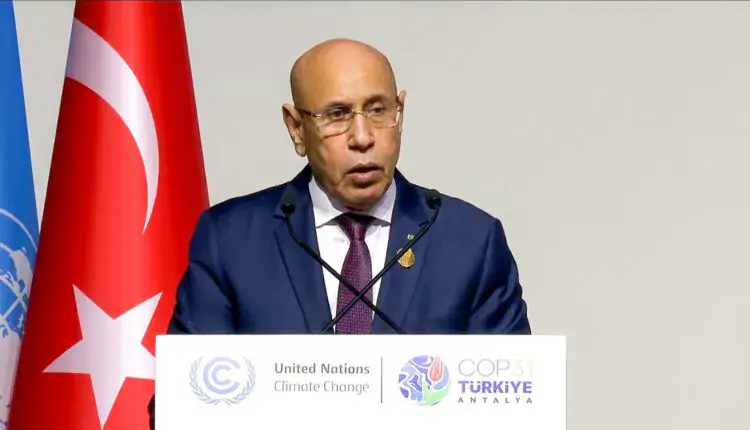
Mauritania's President Mohamed Ould Cheikh El Ghazouani has highlighted the country's vulnerability to climate change, despite its low carbon footprint. He cited devastating consequences such as drought, water scarcity, land degradation, desertification, and coastal erosion. These effects have significantly impacted rural communities, threatening food security and hindering development. The President made these remarks at the 31st Conference of the Parties to the United Nations Framework Convention on Climate Change (COP31) in Antalya.
President Ghazouani emphasized that addressing climate change is a pressing national priority, with far-reaching environmental, social, economic, and security implications. He expressed hope that COP31 would be a crucial step in rebuilding trust among nations, accelerating the implementation of the Paris Agreement, and providing concrete international support to the most vulnerable countries. The President also acknowledged the efforts of Türkiye, Brazil, and Australia in promoting multilateral climate action.
Mauritania has launched ambitious programs to enhance resilience to climate change, restore degraded lands, and combat desertification. The country is actively contributing to the Great Green Wall Initiative and playing a dynamic role in the Climate Commission for the Sahel region and the Inter-State Committee to Combat Drought in the Sahel (CILSS). In November 2025, Mauritania adopted its third Nationally Determined Contribution (NDC3) with a plan to be implemented by 2035.
The Mauritanian government is currently developing an investment plan related to NDC3, while finalizing its National Adaptation Plan. These strategic frameworks aim to improve intervention planning, mobilize necessary resources, and transparently measure progress. The country is also working to strengthen policies for protecting vulnerable populations and responding to climate shocks, including a comprehensive social protection system to support low-income households.
President Ghazouani's efforts to address climate change include structural reforms to integrate climate considerations into public policies, ensuring participation from all stakeholders, including the private sector, scientific research institutions, and civil society. These reforms focus on establishing mechanisms to monitor climate-related expenditures, revising water policies, and reducing greenhouse gas emissions in the extractive sector.
Mauritania is also working to leverage its potential in renewable energies and develop green hydrogen to accelerate its energy transition, attract sustainable investments, and create job opportunities. However, the country still requires increased international support to enhance its resilience and adaptive capacities while ensuring a just and effective energy transition.
President Ghazouani called for mobilizing accessible and adapted climate financing, strengthening technology transfer, and developing institutional capacities. He emphasized the need for international solidarity and accelerated implementation of the Paris Agreement to address the pressing issue of climate change. The President's speech reflected Mauritania's commitment to addressing climate change and its dedication to working with international partners to achieve this goal.
Key points
- President Ghazouani emphasizes climate change as a national priority for Mauritania.
- Mauritania has adopted its third Nationally Determined Contribution (NDC3) with a plan to be implemented by 2035.
- The country calls for increased international support to enhance its resilience and adaptive capacities.