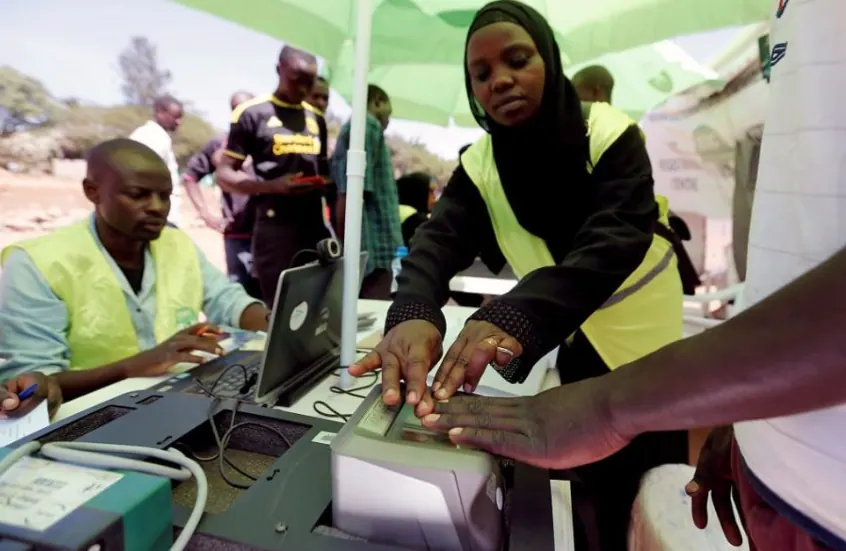
The Independent Electoral and Boundaries Commission (IEBC) of Kenya has introduced new qualification requirements for firms seeking to supply election technology for the 2027 polls. One of the conditions is that firms must demonstrate access to Sh5 billion in financial resources. This move is part of the commission's efforts to ensure that only capable firms participate in the multi-billion-shilling procurement process. The new requirements are contained in an addendum to the tender for the new Integrated Elections Management System.
In addition to demonstrating financial capacity, bidders must have participated in at least two contracts in the last 10 years, each worth at least Sh2 billion. They must also have a track record of handling major information technology contracts, with at least five years of experience in information-system contracts. Furthermore, firms must demonstrate experience in supplying election technology in at least two countries and have handled large numbers of devices. Specifically, a company bidding must show that it has supplied at least 50,000 devices cumulatively between 2021 and 2025.
The IEBC has also demanded that firms provide recommendation letters from five clients on the implementation of election systems and completion certificates from three clients for election-system implementations during 2021-2025. The bidders will also be required to provide documentary evidence from previous clients showing successful implementation of election systems. These requirements are expected to significantly narrow the field of companies capable of bidding for the election technology contract.
The new requirements have raised concerns among poll experts, who fear that the conditions may be skewed to favor a particular contractor. Brian Weke, a poll expert, noted that the requirements appear to be tailored to favor firms that have previously worked with the IEBC. The commission has also been criticized for the clarity and objectivity of some of the technical requirements in the original tender. The Public Procurement Administrative Review Board ordered the IEBC to amend and republish the tender after it was challenged by one of the bidders.
A South Korean company, Miru Systems, has been widely positioned as the frontrunner in the 2027 Kiems tender. The company claims to have provided election technology in several countries, including Congo, Guinea, the Philippines, and Zambia. Smartmatic International, another major player in the election technology sector, says it has provided election technology in about 35 countries. The IEBC has set the post-warranty services period at 24 months and corrected a contentious provision concerning performance security.
The revised tender, published on September 17, pushes the deadline for submission of bids to October 2. The commission has also changed the way the winning bidder can be tested before award of the contract. The best-evaluated bidder's system will undergo conformity tests, eligibility checks, and due diligence before the contract is awarded. This means that emerging top in the technical and financial evaluation will not by itself guarantee the contract.
Poll experts foresee potential challenges with the new conditions, citing concerns about whether local bidders can afford them. Elections Observer Group national coordinator Mule Musau noted that more experienced bidders are likely to have higher costing bids, and the eligibility of local bidders is a major concern. The expert emphasized that the bottom line is to procure equipment and systems that deliver in respect of expected utility with efficiency and effectiveness.
Key points
- The IEBC has set a Sh5bn threshold for firms bidding on the 2027 election technology tender.
- Bidders must have participated in at least two contracts in the last 10 years, each worth at least Sh2 billion.
- The new requirements have raised concerns among poll experts, who fear that the conditions may be skewed to favor a particular contractor.