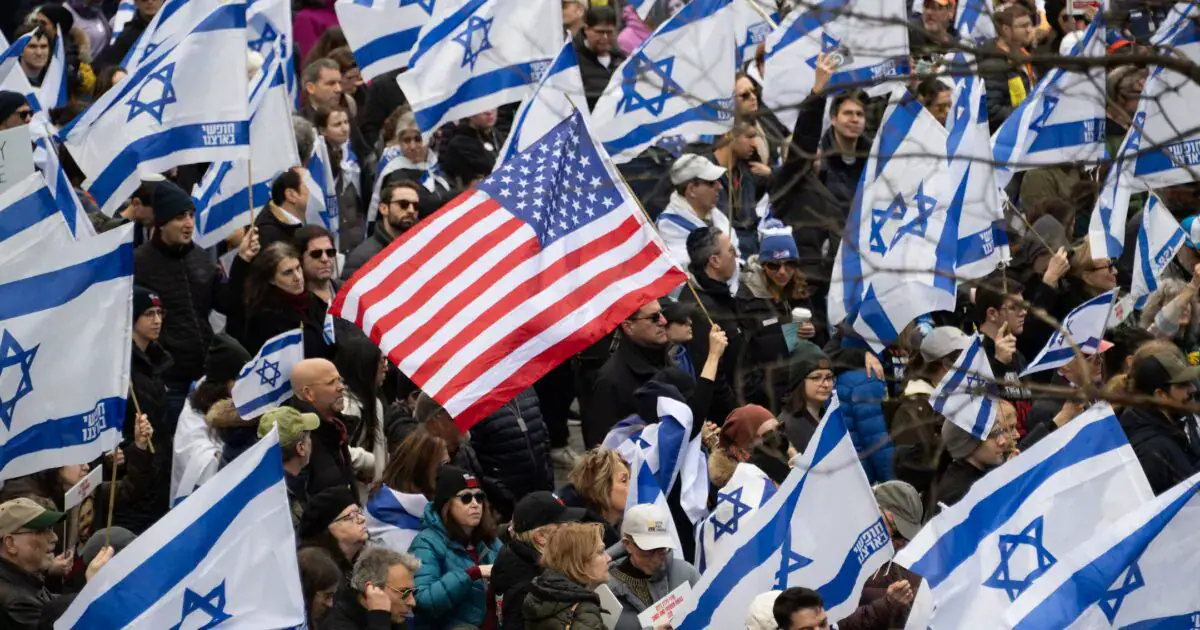
A recent study by the Jewish Telegraphic Agency has found that despite differences in lived experiences, Israeli and American Jews feel a closer sense of peoplehood today than in previous years. The share of American Jews calling Israelis extended family or community has climbed from 46% to 62% since 2021, and the share of Israelis saying the same about American Jews has risen from 45% to 53%.
The study, conducted by Rebecca Caspi and Mimi Kravetz, aimed to understand the nature of differences between US and Israeli Jews by conducting parallel studies and asking questions about key issues. It was found that people with similar viewpoints within each Jewish community shared a political or religious ideology, indicating that it's mostly ideology, not geography, that drives the differences among Jews in both countries.
A majority of American Jews lean left, while a majority of Israeli Jews lean right, with political ideology and religious affiliation closely linked in both countries. In the US and Israel, those who identify with traditional forms of Judaism lean further right, while those who are secular or identify with progressive forms lean further left. This divide is reflected in opinions on issues such as Israeli security and the path to peace.
On questions about Israeli security and the path to peace, significant differences were found between US and Israeli Jews. For instance, 60% of Israelis believe that Israel can remain a democracy while maintaining control over the West Bank/Judea and Samaria, compared with 37% of Americans. Similarly, 55% of Israelis believe that Israeli security and Palestinian statehood are fundamentally incompatible goals, compared with 28% of Americans.
The study also found that disagreements between US and Israeli Jews should not be seen as a rift between the largest global Jewish communities, but rather as disagreements within respective communities. Despite differences, Jews still affirm responsibility for one another, with large majorities of both Israeli Jews and American Jews agreeing that Israeli decision-makers should consider how their actions affect American Jews.
When asked about specific issues on which Israeli decision-makers should consider the impact on American Jews, ideological differences reappeared. For example, on questions of Jewish identity, such as who is recognised as a Jew and Israeli immigration policy, Israeli Jews are far more likely than American Jews to say that Israeli decision-makers should weigh how actions affect American Jews.
The study concludes that ideology, rather than geography, explains where and why US and Israeli Jews disagree. It is possible to disagree and remain one people, as long as that disagreement happens inside a real relationship. The tradition refers to this as "machloket l'shem shamayim," a dispute for the sake of heaven, where disagreements occur within a shared commitment to one another.
Key points
- Ideology drives differences among Jews in the US and Israel more than geography.
- US and Israeli Jews have a closer sense of peoplehood today than in previous years.
- Disagreements between US and Israeli Jews are driven by differences within respective communities rather than a rift between them.