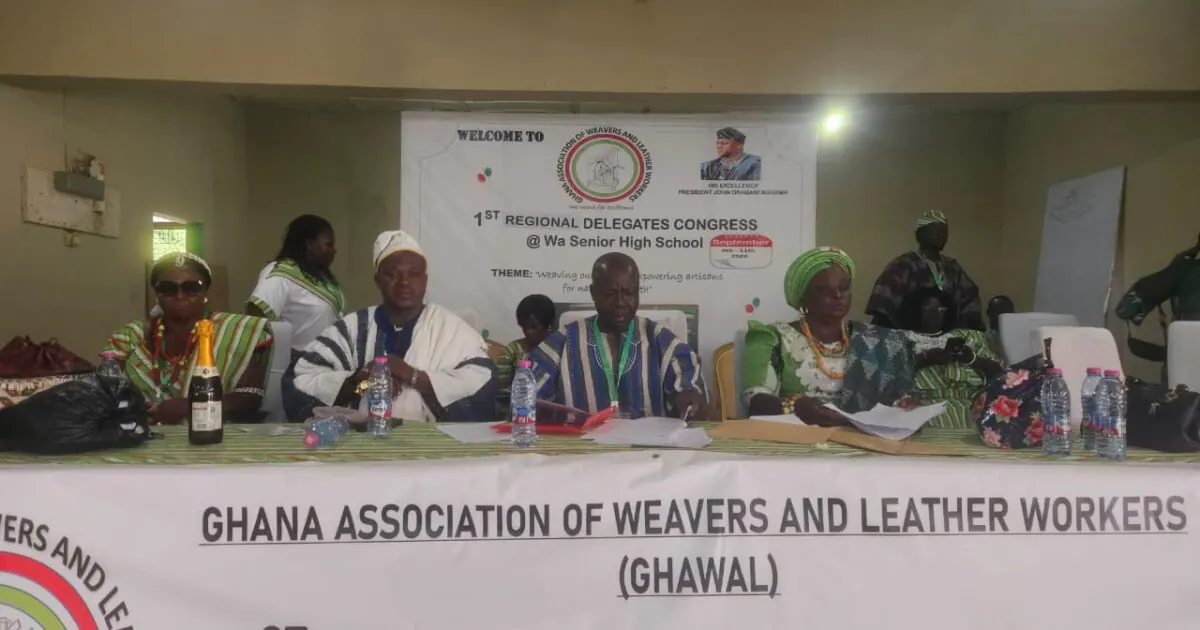
The Industrial and Commercial Workers' Union (ICU) of Ghana has called on smock weavers and leather workers to scale up production for both local and international markets. General Secretary of ICU, Morgan Ayawine, made the call at the first national conference of the Ghana Association of Weavers and Leather Workers (GHAWAL) in Wa, Upper West Region. The conference, themed "Weaving for Future: Empowering Artisans for National Growth," aimed to empower artisans to capitalize on growing interest in Ghanaian crafts.
Smock weaving has historically received less attention than other segments of Ghana's woven cloth industry, with its use largely associated with the cultural traditions of the five northern regions. However, Ayawine noted that the craft has gained wider national and international visibility in recent years. He cited a recent fashion display by contestants of TV3's Ghana's Most Beautiful, where smock material was showcased in contemporary designs, as evidence of the changing perception and use of smock fabric.
The growing popularity of smock fabric presents an opportunity for weavers to expand production and capitalize on the increasing demand. Ayawine challenged weavers to position their businesses to take advantage of the growing visibility and patronage of smock fabrics and related products. He emphasized the need for artisans to move beyond small-scale production and invest in product quality, packaging, branding, marketing, and access to finance.
The African Growth and Opportunity Act (AGOA) offers a potential pathway for Ghanaian textile products to access international markets. Ayawine encouraged GHAWAL to work with the Ghana Export Promotion Authority (GEPA) and other relevant institutions to improve product standards and ensure they meet international requirements. This approach could also be applied to leather and basket products, highlighting the craftsmanship demonstrated in locally made shoes, bags, and other leather goods.
To achieve greater market access, artisans must acquire stronger technical and entrepreneurial skills to operate more competitive businesses. Ayawine urged artisans to embrace innovation and modern technology without losing the cultural identity and traditional craftsmanship that make their products unique. The ICU pledged to provide leadership and support towards projecting the industries and highlighting their contribution to employment, poverty reduction, and economic development.
The conference theme was described as a call to action, urging artisans to organize effectively, improve quality, embrace innovation, and explore new markets. Ayawine assured members that ICU Ghana would provide support towards achieving remarkable success. The proposed collaboration with GEPA and use of existing trade opportunities such as AGOA could provide a framework for artisans and their associations to explore markets beyond Ghana.
The outcome of the conference is expected to be practical, forward-looking, and focused on measurable results. As artisans and producers seek to turn Ghana's traditional crafts into more commercially viable enterprises, improving production capacity, product standards, branding, financing, and access to export markets could help artisans move from largely small-scale operations into more formal and competitive businesses.
Key points
- The ICU urges Ghanaian smock weavers to scale up production for local and export markets.
- Smock weaving has gained wider national and international visibility in recent years.
- The African Growth and Opportunity Act offers a potential pathway for Ghanaian textile products to access international markets.