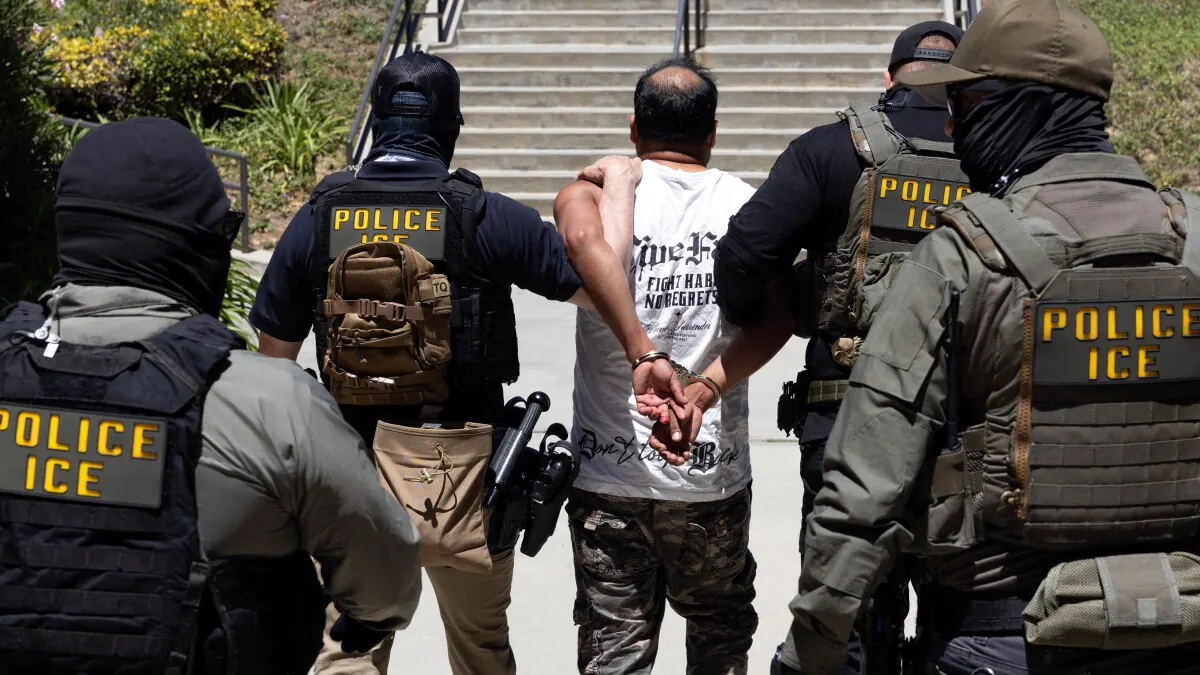
US Immigration and Customs Enforcement (ICE) is planning to create mobile detention facilities for immigrant detainees in Pennsylvania, according to government documents. This move is part of a larger detention expansion that began last year, when ICE became the highest-funded US law enforcement agency with a $75 billion supplement from the One Big Beautiful Bill Act. The expansion comes as ICE has started buying large warehouses nationwide to turn into mega detention centers.
The plans for mobile detention facilities have faced pushback from communities and immigration activists. Acting ICE Director Todd Lyons has described wanting squads of trucks to round up immigrants and have the deportation process run efficiently. However, residents near proposed warehouse locations have expressed concerns about the impact on local infrastructure and humanitarian conditions in the facilities. In Williamsport, Maryland, a resident named Linda Powell expressed worries about the impact on her town, saying, "We don't need it here."
The warehouse project has largely failed, with ICE backing off plans and selling most of the warehouses, according to data gathered by watchdog group Project Salt Box. Despite this, ICE has quietly expanded its detention system in other ways. In the last few months, ICE has detained a record number of immigrants, with roughly 100,000 people arrested in the last two months. Private prison company GEO Group, one of ICE's main contractors, has reported that ICE is aiming to reach 100,000 operational beds.
On Sunday, the Department of Homeland Security signed construction contracts worth over $7 billion to expand immigration detention in several states, including New York, Texas, Arizona, Florida, and California. The department also announced plans to expand detention in Colorado, Washington, and Pennsylvania. Buried in the paperwork is a document regarding expansion in Pennsylvania, which mentions ICE's plans for mobile detention facilities run by GTI, the transportation subsidiary of GEO Group.
The mobile detention facilities will be used to detain immigrants until they can be transferred to a full facility or until the operation is complete. According to the document, women cannot be held in the mobile units for over 10 hours. However, details about the standards for detention, such as access to food, bathroom facilities, and sanitation, are not provided. Michael Wriston, a co-founder of Project Salt Box, expressed concerns about the lack of transparency and the potential for inhumane conditions.
Wriston, a former military intelligence analyst, believes that the focus on Pennsylvania is due to the state's large size and the fact that many police departments are not allowed to work with ICE. This means that detained immigrants cannot be held at local jails. Currently, around 70% of people in ICE detention have no criminal record. Wriston argues that the need for mobile detention centers suggests that the crackdowns are not necessarily targeting hardened criminals.
The mobile detention facilities show the scope of mass deportations, according to Wriston. He believes that the expansion is not targeted immigration enforcement, but rather a large-scale effort to detain and deport immigrants. The development has raised concerns among immigration activists and communities, who argue that the expansion is inhumane and unnecessary.
Key points
- ICE is planning to create mobile detention facilities in Pennsylvania as part of a larger detention expansion.
- The mobile detention facilities will be run by GTI, the transportation subsidiary of GEO Group.
- The expansion has faced pushback from communities and immigration activists, who argue that it is inhumane and unnecessary.