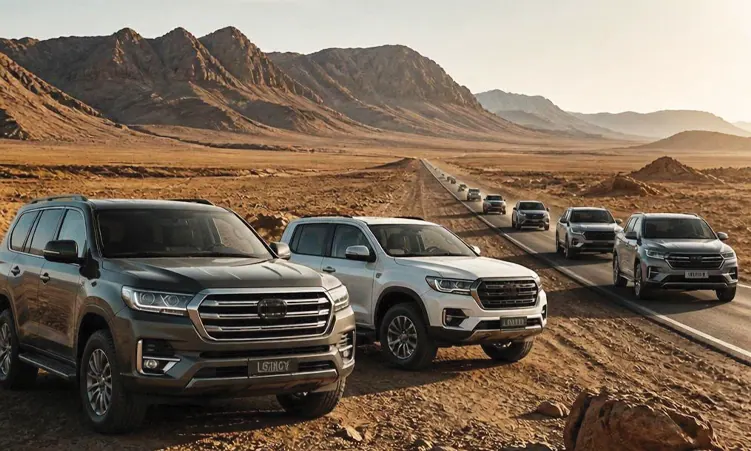
The Namibian vehicle market has undergone significant changes between 2021 and 2025. In 2021, established Japanese, German, American, and Korean brands dominated new-vehicle sales, with Chinese brands occupying a smaller part of the market. However, by 2025, Chinese manufacturers had become serious competitors, with their combined share reaching 9.1% of Namibia's new-vehicle market. This growth indicates a shift in the market dynamics.
In 2021, Namibia sold approximately 9,428 new vehicles, with Toyota leading the market at 34.9%, followed by Volkswagen at 13.7%. Nissan, Ford, and Kia completed the top five, accounting for 65.7% of all vehicles sold. Chinese brands were relatively minor players at this time. The market was heavily influenced by established brands with long histories in Namibia, which had a significant advantage due to their large dealer networks, established parts supply, and familiarity among buyers.
Haval was an important exception, starting to make an impact in Namibia around 2021. According to later market analysis, Haval maintained about 4% market share from 2021 onward. This shows that the Chinese-brand story in Namibia did not suddenly begin in 2025, but rather started earlier with Haval establishing a foothold before other Chinese brands arrived in greater numbers.
In 2022, Namibia's new-vehicle market recovered, with a total of 10,923 vehicles sold, representing growth of about 16%. Haval's sales increased by 24.9% during that year, demonstrating that a Chinese manufacturer could compete successfully in Namibia. This growth was significant, as it showed that Chinese brands could offer competitive alternatives for price-conscious Namibian buyers.
Chinese manufacturers gained attention in 2022 by offering combinations of competitive pricing, more standard equipment, longer warranties, modern SUV designs, and technology normally associated with more expensive vehicles. Local analysts described Chinese vehicles as competitive alternatives for price-conscious Namibian buyers, creating a serious question for established manufacturers: Could traditional brands continue charging a premium simply because buyers trusted the brand?
By 2025, Chinese brands had sold 1,320 vehicles, while Toyota alone sold 8,226. Despite the growth of Chinese brands, traditional brands still dominated the market. The key point is that Chinese brands have not replaced traditional brands in Namibia but have taken a growing share of a market that is still dominated by established manufacturers.
The shift in the Namibian vehicle market indicates a changing landscape, with Chinese brands becoming increasingly competitive. As the market continues to evolve, it will be interesting to see how traditional brands respond to the growing presence of Chinese manufacturers. With consumers becoming increasingly price-conscious, Chinese brands may continue to gain ground in the Namibian market.
Key points
- Chinese brands have increased their market share in Namibia, reaching 9.1% in 2025.
- Haval established a foothold in the Namibian market in 2021, maintaining about 4% market share from 2021 onward.
- Chinese manufacturers are offering competitive alternatives for price-conscious Namibian buyers, with combinations of competitive pricing, more standard equipment, and modern technology.