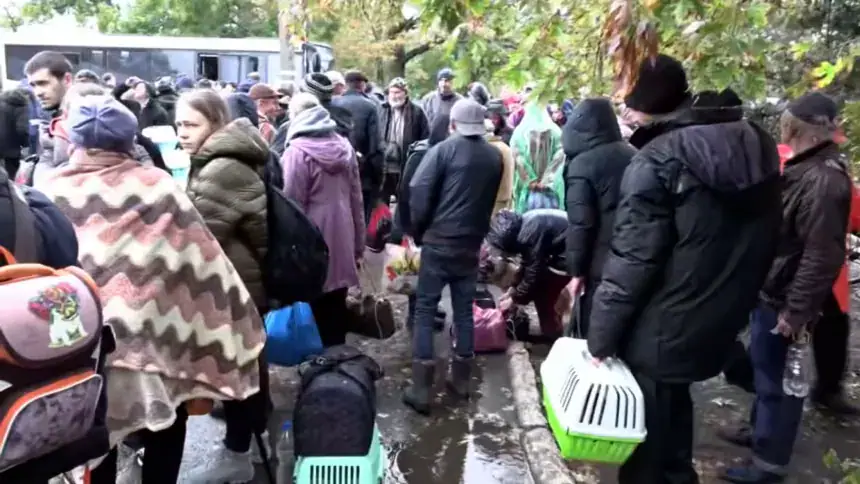
Hundreds of people, including many pets, arrived back in Ukraine on Saturday afternoon after being evacuated from the frontline city of Oleshky under a ceasefire that was helped to be negotiated by first lady Melania Trump. Ukraine's President Volodymyr Zelensky announced the arrival of the evacuees on Telegram, thanking Trump for her mediation. The evacuees had been waiting near the border between Ukraine and Belarus for the bus that would take them back home.
Dmytro, a soldier in the Ukrainian military, had not seen his wife Larisa for 1,711 days. His wife was among those who were evacuated from Oleshky, a town that was occupied by Russia. Larisa had stayed behind, worried that if she tried to leave, she would be picked up at a Russian military checkpoint and subjected to "filtration," a process that involves humiliating and often violent questioning. The couple had managed to get their daughter out, but Larisa had stayed, hoping for a miracle.
The town of Oleshky has suffered greatly since it was occupied by Russia. A major flood in 2023, caused by the collapse of the nearby Nova Kakhovka Dam, resulted in hundreds of deaths and significant damage to the town. The Russian-installed authorities were unable or unwilling to invest in repairs, and the humanitarian situation has deteriorated in recent months. By September, the town had run out of food and other essential supplies, with residents surviving on grass and weeds.
The evacuees will need medical attention and careful feeding, as they have been starving for a long time. The director of the Chernihiv Regional Hospital, Andriy Zhydenko, was waiting at the border with his staff to provide medical assistance to the evacuees. He said that the effects of prolonged malnutrition will be a key concern, and that consuming too much food too quickly could be dangerous. There are also people with injuries, stroke survivors, and those with limited mobility among the evacuees.
Some 40% of Oleshky's pre-war population of around 24,000 managed to flee to Ukraine-controlled territory when it was still possible early in the fighting. Thousands of others have escaped since then, but many remained, either unable or unwilling to leave. Zhanna Ptakhova and her daughters Elizaveta and Daria Paliy were among those who made it out when it was still possible, but Ptakhova's husband, and Elizaveta's and Daria's father, stayed in Oleshky to take care of their home.
The journey out of Oleshky was long and scary, with access routes heavily mined and littered with debris. Ukraine's ombudsman Dmytro Lubinets traveled to Oleshky to personally escort the evacuees into Ukraine-controlled territory, becoming the first high-profile Ukrainian official to openly travel to occupied areas under Russian control and Russia since the start of the war. The evacuees traveled through the occupied Ukrainian peninsula of Crimea to Anapa in Russia's Krasnodar region, and then flew from Anapa airport to Gomel, Belarus.
The evacuation was made possible by a ceasefire called for by Pope Leo XIV and helped to be negotiated by Melania Trump. President Zelensky thanked Trump for her mediation, saying that global attention to the situation in Oleshky had helped to save lives. The evacuees are now receiving medical attention and care, and are slowly rebuilding their lives. The evacuation is a significant development in the ongoing conflict in Ukraine, and a rare instance of cooperation between Ukraine and Russia.
Key points
- Hundreds of people were evacuated from the occupied Ukrainian town of Oleshky under a ceasefire brokered by Melania Trump.
- The town of Oleshky has suffered greatly since it was occupied by Russia, with a major flood in 2023 and a deteriorating humanitarian situation.
- The evacuees will need medical attention and careful feeding, as they have been starving for a long time.