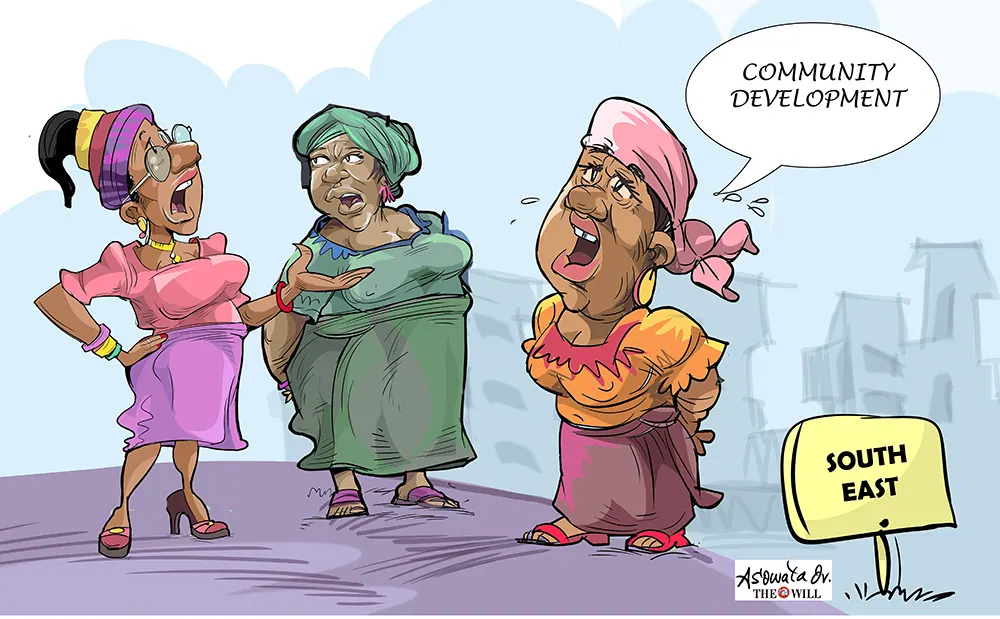
Every August, a significant event takes place across Nigeria's South-East region. The August Meeting, a traditional gathering of women, has evolved into a community development initiative. Thousands of women return home from various parts of the world, including Lagos, Abuja, and Port Harcourt, to participate in meetings, speeches, fund-raising, and communal celebrations. This cultural ritual has survived for generations and has become an essential part of the region's community development efforts.
The August Meeting is more than just a social gathering; it's an indigenous model of grassroots development that has been in existence for years. Women contribute money to various community projects, such as school construction, supporting widows, rehabilitating roads, equipping health centers, providing borehole water, assisting vulnerable families, awarding scholarships, or financing community security initiatives. The collective efforts of these women have shown that community development can be achieved through collaborative efforts.
Community development is often associated with the construction of physical infrastructure, but it goes beyond that. It's a process where people collectively identify their needs, mobilize resources, and participate in solving problems that affect their lives. In Nigeria, development planning has been centralized for decades, with federal and state governments formulating policies and executing projects, while communities remain passive recipients. The August Meeting demonstrates a different approach, one that emphasizes community ownership and participation.
The strength of the August Meeting lies in its sense of ownership. When women from a community identify a problem, contribute towards solving it, and participate in monitoring the project, the intervention becomes a community asset. This sense of ownership determines whether a project survives or not. A project constructed without community involvement may deteriorate, but when residents have contributed their resources, labor, or social capital, they are more likely to protect and maintain what they have created.
The August Meeting has also demonstrated the economic power of collective action. One woman may not be able to construct a health center, but together, thousands of women can mobilize resources that governments sometimes struggle to deploy efficiently at the grassroots. This economics of collective action is not new, as traditional self-help associations, town unions, age grades, development unions, and women's organizations have historically played major roles in financing community infrastructure across the South-East.
The August Meeting has attracted the attention of big, multinational companies, such as Nestle Nigeria, to support community development projects. Nestle's Maggi sponsored the annual August Meeting across five states in South-East Nigeria, reaching over 8,100 women in 18 locations in 2025 and 2026. The program provided nutrition education, culinary demonstrations, and workshops on family well-being and economic empowerment. This partnership has shown that community development can be achieved through collaboration with external organizations.
The annual migration of women for the August Meeting can become a development resource. Women living in Abuja, Lagos, or in the diaspora can contribute to community projects, finance scholarships or healthcare programs, or invest in their villages. This has enormous implications for Nigeria, as the government cannot realistically finance every development requirement from Abuja or state capitals. A framework that encourages communities, businesses, philanthropists, civil society organizations, and governments to pool resources is necessary for sustainable development.
Key points
- The August Meeting demonstrates a different approach to community development, one that emphasizes community ownership and participation.
- The collective efforts of women in the August Meeting have shown that community development can be achieved through collaborative efforts.
- The August Meeting has attracted the attention of big, multinational companies, such as Nestle Nigeria, to support community development projects.