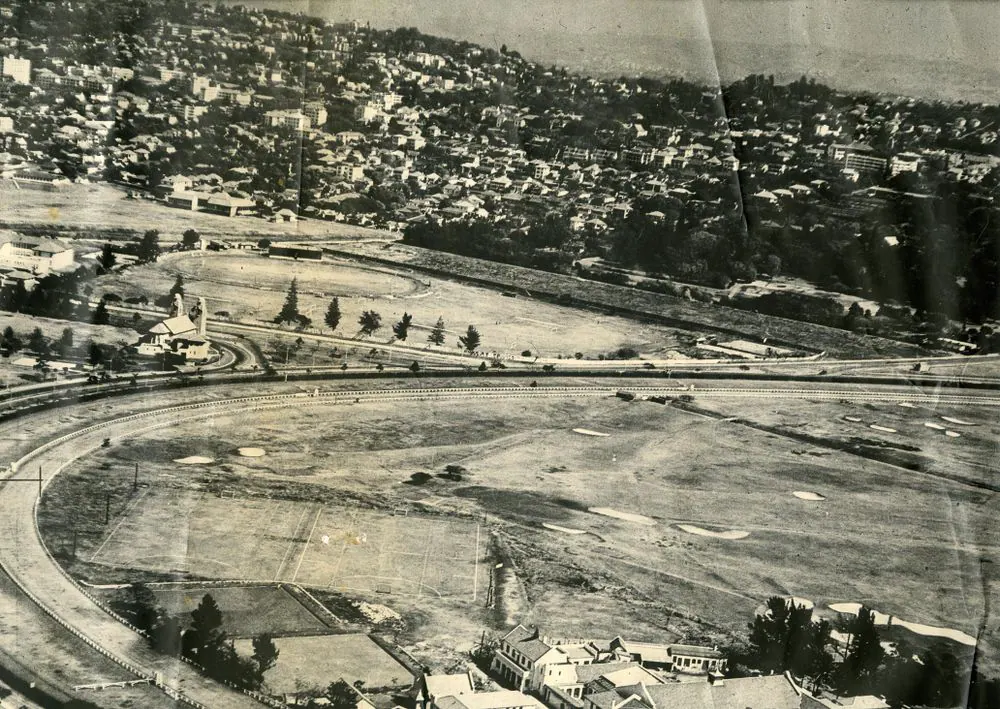
Curries Fountain, a popular sports field in Durban, South Africa, has its origins dating back to the 1870s when a waterworks, Durban's first reliable water source, was situated in the area. The waterworks and tower, named Currie's Fountain, had long ceased to exist, but the name remained, spelt without the 's', when the area became a sports ground. The site was formally established as a sports facility for the Indian community in 1925 and catered to various sports, including golf, cycling, athletics, tennis, soccer, and cricket.
By the time the original lease expired in 1950, Curries Fountain had become a premier sports facility, boasting six soccer fields, four cricket pitches, three tennis courts, a quarter-mile cinder track, a nine-hole golf course, a refreshment room, and a clock tower. The venue played host to numerous high-profile events, including soccer and cricket matches, and was a hub for sports enthusiasts. The site also hosted boxing bouts, with promoter Nat Moodley staging an open-air boxing tournament in the late 1940s, featuring local favourite Mannie Dixon.
Curries Fountain was also home to several notable boxers, including Elijah "Tap Tap" Makhatini and Maxwell Malinga, who engaged in a series of matches at the venue. In 1974, Malinga drew with American Alvin Anderson, the then World Boxing Council's No. 6 world-ranked fighter, over 10 rounds. Makhatini, regarded as one of the best fighters in the country in his heyday, won 11 straight fights at Curries before meeting Joseph Sishi for the Natal Middleweight Championship in 1971.
In addition to boxing and soccer, Curries Fountain also hosted golf events, with the Durban Golf Club, founded in 1928, laying nine tees and greens on the boundary fence of the sports ground. The golf course, with a par of 68, was the first for non-whites in the country and served as the home of Indian golfers in Natal for over 25 years. The club was allowed to use the golf course only on Saturday and Sunday mornings and whenever there were no soccer or cricket fixtures.
Curries Fountain played a significant role in South African soccer history, hosting several high-profile matches, including a tour by a soccer team from India in 1934. The venue also hosted the Sam China Cup, a premier soccer competition, and the first match of the professional South African Soccer League, which was played between Aces United and Blackpool United in 1961. The site was also the birthplace of the South African Soccer Federation, which was founded and launched at Curries Fountain on September 30, 1951.
The Federation Professional League, launched in the 1960s, conducted its affairs from an undertaker's parlour in Grey Street, with seven teams, including Avalon Athletics, Aces United, and Maritzburg City. Despite facing sponsorship challenges, the league grew to become national in character, with teams from the Cape joining, and eventually had 15 clubs competing for a total prize-money of R100 000. The league's Cup Finals were premier soccer events, drawing capacity crowds made up of young and old supporters, vendors, police, and businessmen.
Curries Fountain also had a significant impact on South African politics, with Queen Elizabeth visiting the stadium in 1947. The site hosted various inter-race soccer tournaments, including the Singh Trophy, and played a role in promoting unity among different racial groups through sports. Although the Federation Professional League disbanded in 1990, Curries Fountain remains a landmark in South African sport and politics, a testament to the country's rich sporting history.
Key points
- Curries Fountain was a premier sports facility in Durban, hosting various sports events, including soccer, cricket, boxing, and golf.
- The site played a significant role in South African soccer history, hosting high-profile matches and serving as the birthplace of the South African Soccer Federation.
- Curries Fountain was also a significant landmark in South African politics, hosting Queen Elizabeth in 1947 and promoting unity among different racial groups through sports.