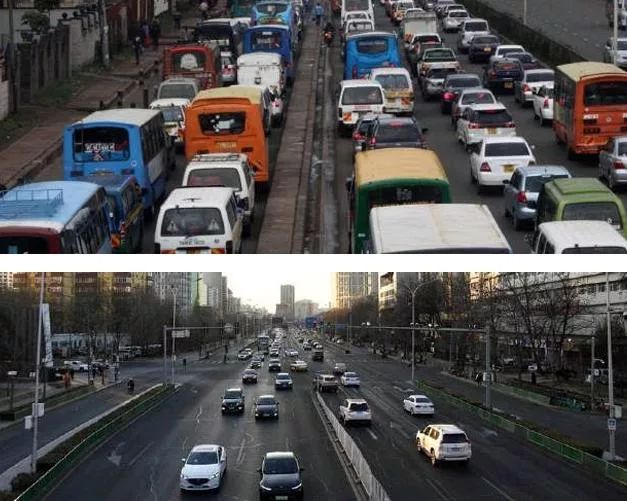
Beijing, with 22 million people and over seven million cars, has implemented an odd-even ban policy to manage traffic. The policy bans 20% of private cars from the 5th Ring Road, the city's urban heart, every weekday from 7am to 8pm. The ban is based on the last digit of the car's number plate, rotating every 13 weeks. This system has reduced the number of cars on the road by 20% every weekday.
The ban has led to a significant reduction in traffic congestion and pollution in Beijing. Data from 1,500 monitoring stations shows that rush-hour speed in the city centre has increased by 10%, while PM2.5 pollution has dropped by 21%. The city's public transport system, including 27 subway lines, provides a reliable alternative to private cars. Beijing residents have expressed willingness to comply with the ban, citing the availability of free buses and allowances for public transportation.
Nairobi, on the other hand, faces a severe traffic crisis, with commuters spending an average of 57 minutes on the road. The city loses Sh130 billion every year to traffic, with projections suggesting it could hit Sh1 trillion by 2063. The Nairobi Metropolitan Mass Rapid Transit System, a proposed 30-kilometre underground metro, aims to ease traffic congestion. However, Governor Johnson Sakaja's plan requires significant investment and infrastructure development.
Experts believe that Nairobi can learn from Beijing's experience in managing traffic. The city's traffic crisis is largely a problem of discipline and alternatives, rather than road capacity. Implementing measures to manage road use, enforce traffic rules, and provide reliable public transport can help reduce congestion. The proposed metro system must be matched by immediate measures to address the city's traffic woes.
The Beijing Transportation Research Center has reported that the ban has been effective in reducing traffic congestion. The centre's data shows that the ban has led to a significant reduction in the number of cars on the road, resulting in increased speed and reduced pollution. The city's experience suggests that restricting private cars can work when enforcement is credible and public transport offers a practical substitute.
In contrast, Nairobi's traffic crisis is exacerbated by a lack of planning and inadequate public transport. The city's matatu system is often chaotic, with overlapping routes and illegal parking. The proposed BRT system has been delayed, and the city's traffic lights are not automated. Governor Sakaja's plan for a metro system is ambitious, but it requires significant investment and infrastructure development.
The lesson from Beijing's experience is that restricting private cars can be an effective measure in managing traffic congestion. However, it requires a reliable public transport system and credible enforcement. Nairobi must consider implementing measures to manage road use and provide alternatives to private cars. The proposed metro system is a long-term solution, but immediate measures are needed to address the city's traffic crisis.
Key points
- Beijing's odd-even ban policy has reduced traffic congestion and pollution by 20% and 21%, respectively.
- Nairobi loses Sh130 billion every year to traffic, with projections suggesting it could hit Sh1 trillion by 2063.
- The proposed Nairobi Metropolitan Mass Rapid Transit System aims to ease traffic congestion with a 30-kilometre underground metro.