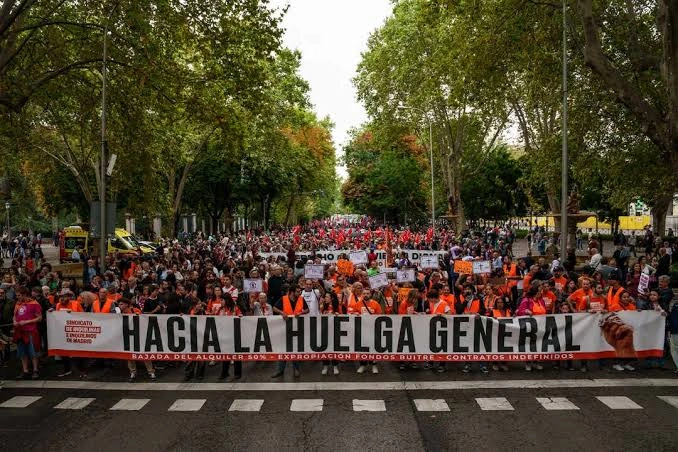
On Saturday, thousands of Spaniards took to the streets in over 50 cities to demand immediate solutions to the country's housing crisis. The protests, which were one of the largest in recent years, came a day after the Spanish parliament rejected two bills proposed by the government of Prime Minister Pedro Sanchez aimed at mitigating the crisis and protecting tenants. The demonstrations were sparked by rising rents and housing prices, which have nearly doubled in the past decade.
The protests were most intense in Madrid, where authorities estimated that around 70,000 people participated, while organizers claimed that up to 500,000 people joined the march. The protesters, who marched from four different locations before converging on the Cibeles square, demanded a 50% reduction in rents, indefinite rental contracts, and stricter regulations on large landlords and investment funds. They also called for the government to intervene more heavily in the housing market to address speculation and ensure that housing is treated as a fundamental right, not just a commodity.
The housing crisis has had a devastating impact on many Spaniards, with average rents increasing by nearly 50% in the past decade and housing prices rising by around 90%. In Madrid, a 26-year-old man reported that he and his friends had to pay €900 per month for a two-bedroom apartment, while a one-bedroom apartment now costs around €1,000 per month, equivalent to nearly half the average monthly salary in the capital. The protesters also highlighted the case of 87-year-old Maria Carmen Abascal, who was forced to leave her home of nearly 70 years after the landlord increased the rent by 275%.
The protests were not limited to Madrid, with demonstrations taking place in cities such as Valencia, Santander, and Seville. In Santander, over 2,000 people participated, while in Palma, around 3,000 people joined the protest. The demonstrations were largely peaceful, but there were reports of clashes between protesters and police in some cities. In Valencia, protesters attempted to reach a site hosting a real estate investment forum, leading to the arrest of one person and the injury of nine police officers.
The Spanish government has faced criticism for its handling of the housing crisis, with many accusing Prime Minister Sanchez of not doing enough to address the issue. The rejection of the two bills proposed by the government has been seen as a major setback for efforts to protect tenants and regulate the housing market. The opposition has called for early elections, with the leader of the People's Party, Alberto Nunez Feijoo, using the crisis to attack the government.
The protests have also highlighted divisions within the Spanish government, with some parties, such as the Catalan party Junts, opposing the proposed measures. The government has faced pressure to take more decisive action to address the housing crisis, with many calling for a comprehensive plan to regulate the housing market and protect tenants. The protests have also sparked concerns about the potential for further social unrest if the crisis is not addressed.
The housing crisis is expected to continue to be a major issue in Spain, with many experts warning that the situation is likely to worsen in the coming months. The protests have sparked a national conversation about the need for affordable housing and the role of the government in regulating the housing market. As the crisis deepens, it remains to be seen how the government will respond to the growing pressure to take action.
Key points
- The protests were sparked by rising rents and housing prices, which have nearly doubled in the past decade.
- The protesters demanded a 50% reduction in rents, indefinite rental contracts, and stricter regulations on large landlords and investment funds.
- The housing crisis has had a devastating impact on many Spaniards, with average rents increasing by nearly 50% in the past decade and housing prices rising by around 90%.