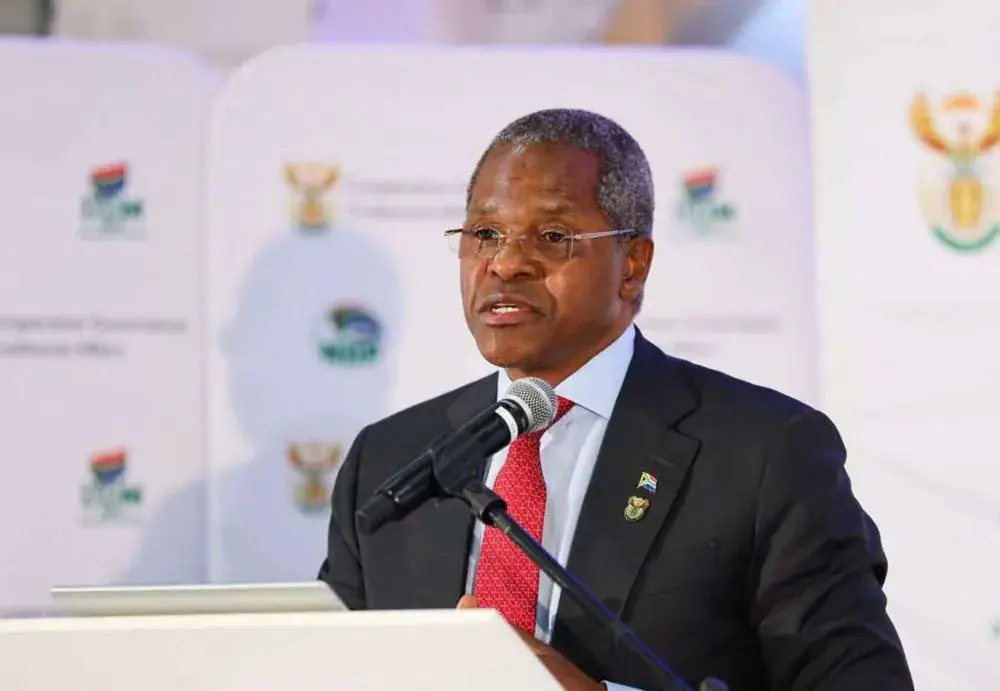
Cooperative Governance and Traditional Affairs Minister Velenkosini Hlabisa has emphasized the need for municipalities and government institutions to harness technology to enhance disaster warning systems. Speaking at the Drones, AI and GIS for Disaster Risk Management in Southern Africa Conference in Umhlanga, Hlabisa highlighted the importance of leveraging technology to identify disaster risks, improve early warnings, and protect communities. He noted that disasters are testing the ability of governments, municipalities, and communities to anticipate, prepare for, respond to, and recover from emergencies.
Hlabisa pointed out that climate variability, rapid urbanization, environmental degradation, infrastructure vulnerability, and socioeconomic inequality are increasing communities' exposure to risk. He stressed that drones, artificial intelligence (AI), and geographic information systems (GIS) can help authorities understand risks, improve early warnings, protect critical infrastructure, and respond more effectively to disasters. Drones, in particular, can provide access to areas that are difficult or dangerous to reach during floods, allowing authorities to identify affected settlements, damaged infrastructure, and isolated communities.
The Minister highlighted the potential of AI in disaster management, enabling institutions to analyze weather information, historical disaster patterns, satellite imagery, population data, and infrastructure information to identify emerging risks and support predictive analysis. GIS is also crucial, as it helps authorities understand where risks exist, who is exposed, and what infrastructure, services, and resources may be affected. Hlabisa emphasized that disaster-risk information should inform municipalities' spatial and development planning, human settlements, roads, water and sanitation, environmental management, and infrastructure investment.
Hlabisa noted that a municipality that understands its risks is better positioned to plan responsibly, protect its residents, and reduce the human and financial costs associated with disasters. He also announced that the Department of Cooperative Governance and Traditional Affairs and the Department of Defence are finalizing a revised National Disaster Management Framework through the Cabinet process. The revised framework aims to be agile and resilient, with a focus on strengthening institutional capacity, investing in skills development, and promoting responsible innovation.
However, Hlabisa cautioned that technology should strengthen rather than replace local knowledge, and public institutions need the capacity to understand, procure, govern, and use new technologies effectively and responsibly. He also emphasized that AI cannot replace human judgment, professional expertise, or institutional accountability. In terms of early-warning systems, Hlabisa stressed that warnings must reach people at risk in time, in a form they can understand, and through channels they can access, with particular attention to vulnerable groups such as the elderly, children, and people with disabilities.
Hlabisa called for stronger cooperation among Southern African Development Community member states, as floods, droughts, and severe weather systems can affect communities across national borders. He urged the conference to focus on identifying sustainable financing mechanisms and promoting responsible innovation. The Minister emphasized that the true measure of success will not be the sophistication of technology, but rather its effectiveness in reducing risk, protecting lives, and securing livelihoods.
The conference aims to bring together experts and stakeholders to discuss the role of technology in disaster risk management. Hlabisa's call to action underscores the need for a more proactive and technology-driven approach to disaster management in South Africa and the broader Southern African region. By leveraging AI, drones, and GIS, municipalities can enhance their disaster response and mitigation efforts, ultimately reducing the impact of disasters on communities.
Key points
- Municipalities should use technology like AI, drones, and GIS to improve disaster risk management and early warning systems.
- The revised National Disaster Management Framework aims to be agile and resilient, with a focus on strengthening institutional capacity and promoting responsible innovation.
- Technology should strengthen rather than replace local knowledge in disaster management.